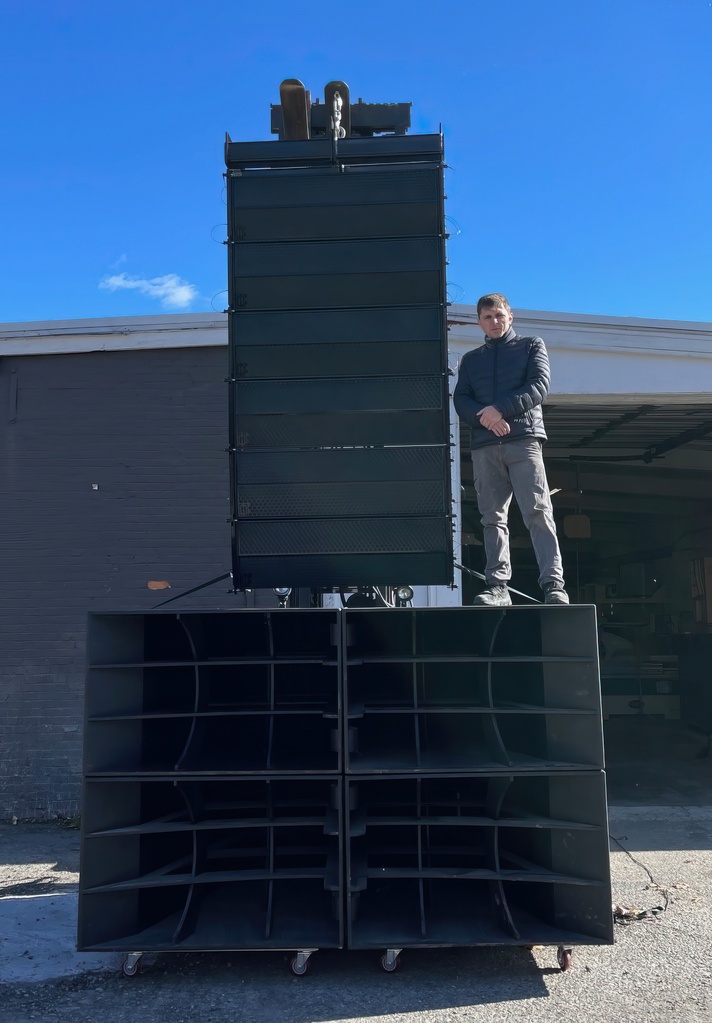
Originally founded by Bob Trinanes in 2014 as Hennessey Sound Designs, HSD Sound Systems emerged from a lifelong passion for sound and speaker building in the DIY world. Today they are a household name on the EDM festival circuit providing loudspeakers for the One Vibe Festival, Resonance, Electric Forest, Miami Music Week and many others. We spoke with Bob Trinanes about the path he’s taken from Hennessey’s humble beginnings helping people in online forums, to moving people today with HSD’s high-impact loudspeakers on the world’s largest festival stages. In our interview, he shares his philosophies behind compelling speaker design. Trinanes also shares that he’s upgraded HSD’s most acclaimed loudspeakers with Celestion’s TSQ Series drivers, including the TSQ1845, TSQ2145, and TSQ2460, which set a new standard in ultra-high powered LF drivers for unwavering performance and longevity. .
Tell us how you got your start in pro audio?
My journey began in car audio, working on manufactured demo vehicles. This transitioned into home audio, where I also ran a business. Ultimately, my love for sound, music, and building speakers led me to pro audio. I was inspired to build a sound system after visiting the Cosmopolitan in Vegas and experiencing their rig. This led me to open a nightclub here, and the sound system was a great success. People began calling, asking who built it, and that’s how Hennessey Sound Design started – almost by accident. I’ve been a woodworker and building speakers since I was 14, working under the table at a New England stereo store; it’s a passion that has stayed with me.
Tell us more about HSD Sound Systems.
We officially started HSD as Hennessey Sound Design, in 2014 due to inquiries for custom speakers. We began in the DIY world, initially helping people on forums, which generated interest. Other venues, production companies, and DJs also sought our sound systems. I converted half of my motorcycle shop into our manufacturing facility in Fall River, where we do everything in-house: assembly, paint, and shipping. We are one of the few companies that handle all these processes internally. A few years ago, we changed the name to HSD Sound Systems, which better represents the brand where we are today.
How did you transition from nightclubs to festivals?
The transition was natural. Some early clients who wanted speakers built were small production companies doing small festival stages. More significantly, we built a sound system for ourselves and traveled nationwide, often at a financial loss, just to demonstrate our speakers. We loaded up trucks and trailers, went to shows, and got hired, primarily to spread awareness. This direct exposure led to orders and our growth.
We started with smaller gigs, like providing sound reinforcement for venues with inadequate house systems. We then moved on to significant deployments at events such as One Vibe Festival, Resonance, Electric Forest, and many engagements during Miami Music Week. We’ve since become a household name in the industry. Initially, we deployed small setups, typically four subs, four tops, and four kicks. This scaled and grew as we expanded our client base across the country.
What’s important to nightclub customers? And how’s it different from what’s important to festival customers?
The core speaker build remains consistent for both. Finishes might differ for installed venues, where we can be more creative, as durability against touring and the elements is less of a concern. Many electronic music industry clients, including those purchasing venue installations, are also festival-goers, so their needs often overlap. We have models that are versatile for both installed and touring environments, equipped with necessary features like fly points for installation
Custom stain finishes and color combinations, while not ideal for touring, significantly boosted our visibility in the community. A black speaker might get 5-10,000 likes online, but a custom-colored one can get 50-100,000. This customization, though more complex than simple black paint, has drastically helped our company evolve. About 75% of our rigs now go out the door with custom colors.
What’s your process for approaching a new speaker or system design?
We previously had custom processes, making systems to order. That wasn’t sustainable long-term and no longer take completely custom orders, as it’s too difficult.
Now, we offer about 20-25 different SKUs. We manufacture these models in batches, leaving them in raw wood for custom coloring later. We have specific models that can be grouped to meet budget constraints or crowd size requirements. Our approach is to build specific models in batches to fulfill orders. The only customization we offer now is CNC touches for logos and color combinations. Otherwise, they are specific models from our lineup.
When specifying drivers for products, what do you look for?
We select drivers based on various parameters, aiming for sub-30 hertz performance in our subwoofers. We are known for achieving low corners below 30 hertz. Often, we design the box first, then model many different drivers to find the one that provides the best edge. We test everyone’s 21-inch or 24-inch drivers to find even a slight advantage. We’ve been extremely pleased with Celestion the new TSQ line in that regard.
Through blind listening tests, where shop personnel don’t know which driver they are hearing, Celestion drivers consistently sound amazing and are winners, even in boxes that were not originally designed for Celestion drivers. We find the new TSQ drivers handle power well, sound phenomenal, and are very musical.
We have an internal saying: “Can it survive a week at Burning Man?” Our biggest concern is longevity, but sufficient real-world use confirms their durability under the abuse our clients’ applications demand. We know Celestion has the capability to build rugged products for our market.
And Celestion definitely has an edge, in offering great value for the money. Even their top-of-the-line products are competitively priced compared to other companies.
Celestion’s new TSQ line definitely meets all of these standards.
Has that led to you using the Celestion TSQ-Series in your designs?
We’ve used Celestion in the past, appreciating the company, especially in our more economical subs like the DJ monitor and booth sub but we always wanted something more powerful. When Celestion released their new heavy-hitter TSQ line, we were among the first in the country to test them.
We’ve now incorporated the Celestion 24” TSQ2460 in our Sherman model, a massive horn-loaded sub. It’s a tank, weighing 440-50 pounds, measuring 72 inches deep, 48 inches by 30 inches, with a low corner of 29 hertz. Despite their size, people are drawn to the immense sound they produce.
The Sherman was initially designed around a different 24-inch driver from another manufacturer, but we needed to pause production because the driver was fragile, and we experienced failures during torture tests.
After testing five different 24-inch drivers in this box, the Celestion TSQ2460 immediately stood out for its sound quality and exceptional durability, handling abuse and power much better.
Now that the TSQ2460 is widely available, the Sherman is back in production and we imagine it’s going to regain its popularity. In fact, we have already locked in our first sale for six new TSQ-loaded Sherman subs during a customer demo last week.
And how about the TSQ2145?
Like the TSQ2460, he 21” Celestion TSQ2145 is now used in the Tomahawk, our 21-inch model, which is popular despite being an economical option. The 21-inch can compete with legacy products that are 100 pounds heavier and $1,000 more expensive, making it a popular, lightweight choice.
We sometimes try to guide clients toward the 21-inch Tomahawk if their crew is small, but the Sharman’s 24-inch’s sound often persuades them. We make some speakers simply because we can, not always expecting high sales, but the market for large, high-output subs is surprisingly strong.
The 18” TSQ1845 is now used in our DJ18 subwoofer monitor and while not in Celestion’s TSQ series, I’d like to mention that we chose the FTX1225 for our REF12 high-performance powered point source speaker to provide the exceptional clarity we were striving for with that speaker.
Is there anything that I didn’t ask you that you feel would make the story more complete or compelling?
I would emphasize that Celestion is one of the easiest companies to work with. I value their flexibility in accommodating our specific specifications for different needs. Not all manufacturers offer that level of support.