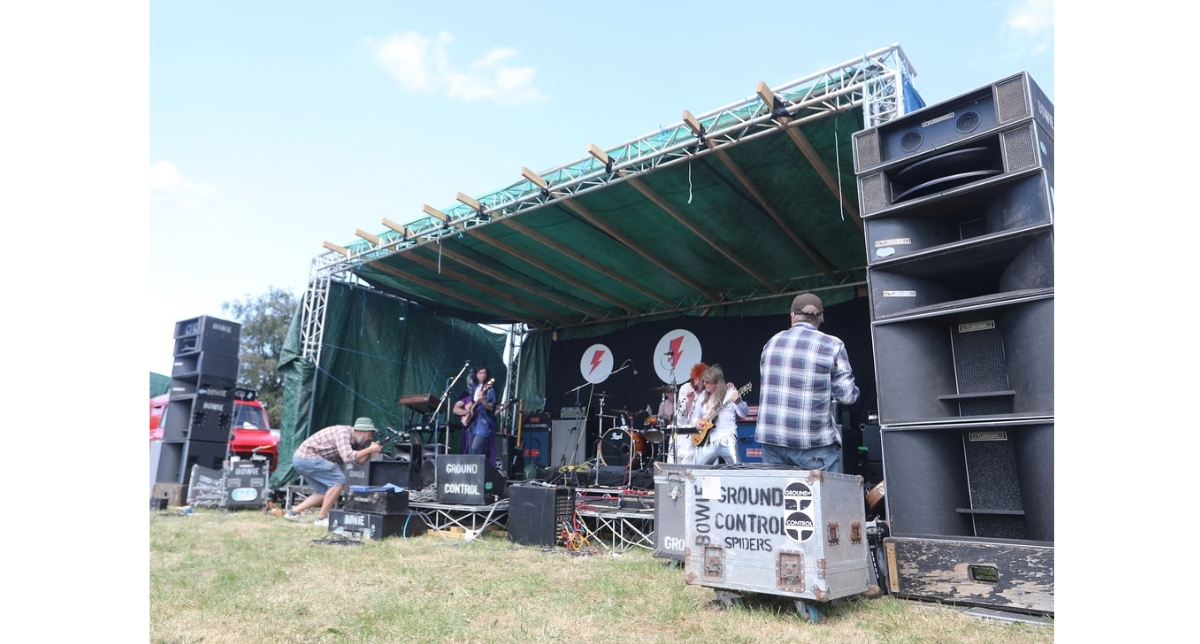
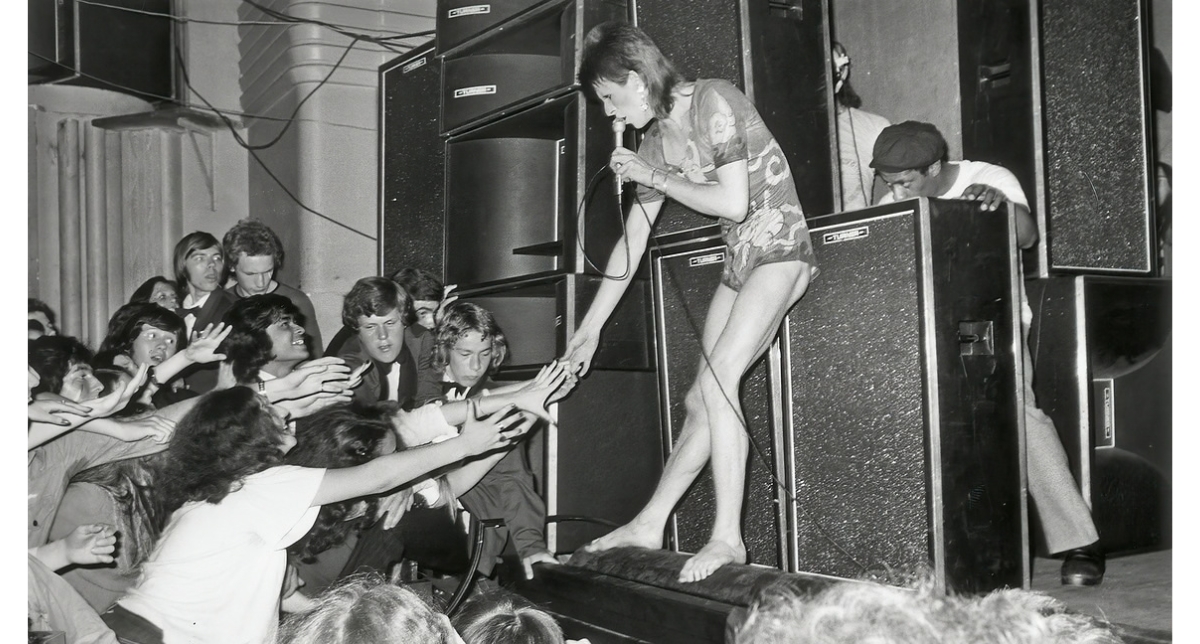
Following the global success of his Pink Floyd Live at Pompeii PA restoration, renowned audio historian Chris Hewitt of CH Vintage Audio has completed his latest masterpiece: the relaunch of David Bowie’s 1972–73, Celestion-loaded Ziggy Stardust and the Spiders from Mars “Ground Control” PA system. Originally created by Turner Audio, this historic analogue wall of sound was officially relaunched in July 2026. The legendary rig served as the sonic engine behind David Bowie and Mick Ronson during their creative zenith, culminating in the final, iconic Ziggy concert at London’s Hammersmith Odeon in July 1973.
At the heart of this iconic, fully restored analogue system is a series of classic, Celestion drivers. We caught up with Chris to discuss the painstaking process of tracking down the original cabinets, the unique design of Turner’s enclosure cabinets, and why in his opinion, classic analogue audio continues to outshine modern digital rigs.
Your restoration of Pink Floyd’s Pompeii system was a massive success. Did that directly inspire you to tackle David Bowie’s Ziggy Stardust PA?
Yes, it did. Following the Pompeii project, we also recommissioned Pink Floyd’s Dark Side of the Moon PA. Once we had succeeded with those rigs, the David Bowie system was the logical next step.
How did you manage to acquire Bowie’s original Ground Control system?
It’s a classic rock ’n’ roll story. I was supplying the vintage PA systems for Danny Boyle’s Sex Pistols television series, Pistol. The opening scene dramatises the Pistols breaking into the Hammersmith Odeon during Bowie’s final Ziggy gig to steal his microphones. I had to build a replica of Bowie’s stage setup for that shoot, so I knew what I was looking for.
Shortly after, I was at the PLASA show in London and a chap came up to me. He said, “I’ve seen what you’re doing. I actually have David Bowie’s Ground Control system from the Spiders from Mars tour sitting in my garden shed in Slough.”
I hear these kinds of claims all the time, and 90% of them turn out to be nonsense. But we exchanged cards, and a year later, he rang me to say he’d dug it all out. I drove down in my truck and picked up the authentic cabinets. We spent the next three to four years contacting the original crew, gathering schematics, and rebuilding the rig to its exact historical spec.
What is the historical background of how David Bowie ended up using this particular system?
It started with Tucky Buzzard, a band produced by Bill Wyman and managed by Tony Defries, who also managed David Bowie on his early rise to global stardom. Tony had bought a Turner PA system for Tucky Buzzard’s tour and one night, Defries put a young Bowie on the bill as a support act. This was before the Spiders from Mars band, and it was just David and guitarist Mick Ronson on stage.
Bowie was incredibly impressed by the sound of the Turner PA and spoke to the soundman, Robin Mayhew, about running his live audio. Recognising Bowie’s star potential, Defries bought the PA back from Tucky Buzzard, expanded it, and hired Robin to run the sound. The Turner Ground Control PA was born, eventually expanding to a 24-channel Turner mixer powering legendary tours across the UK, America and Japan.
What did Bowie find so special about the Turner Ground Control system?
Bowie absolutely loved the system because of how it controlled feedback. The cabinet designs allowed him to climb up onto the stacks or sing directly in front of them without any feedback issues.
Turner utilized very unusual designs. He used reflex cabinets—similar in size to a traditional WEM 4×12 but wider—with a 15-inch speaker facing backwards, ported at both the top and bottom. Above that sat a front-facing 15-inch flare bass bin, a 10-inch midrange cabinet, and various high-frequency horns. Visually, the system was very distinct because Turner fitted custom one-inch aluminium trim on the edges of all his cabinets.
Which Celestion drivers are featured inside this restored Bowie system?
Inside the speaker stacks, the 10-inch midrange cabinets are loaded with Celestion G10L-35 10-inch drivers, and several of the high-frequency horn boxes are fitted with Celestion DC100 compression drivers. Additionally, we have Celestion T1791 G15C 15-inch drivers running inside the reflex bass bins.
It’s also worth noting that Mick Ronson’s legendary guitar tone was driven by Celestion. On stage with the Spiders, Ronson ran a 200-watt Marshall head through Marshall cabinets loaded with classic Celestion Greenbacks. So Celestion’s signature sound was truly voicing both the instruments and the main PA on those tours.
Did you have to do extensive restoration work to bring this decades old PA back to life?
Fortunately, I have accumulated a massive stock of vintage 1970s Celestion speakers on the shelves of my workshop—from 10s and 12s to rare pre-Rola drivers—all of which are fully functional. This made it straightforward to load the cabinets with historically correct, working components to get the system operational.
How are the crossovers set up on the Turner system?
In the early Ziggy era of 1972, they ran the PA full range with no electronic crossovers. They used passive capacitors on the positive leg of the horn drivers to protect them and set the crossover frequency, but the 15-inch and 10-inch drivers were getting the same full-range signal. By late 1972 and early 1973, Turner introduced a two-way crossover. We have restored the system to accommodate both options, allowing us to experiment with both historical configurations.
You officially unveiled the system with a live band. What was it like hearing David Bowie’s music through the restored rig for the first time?
It sounded absolutely magnificent—so organic and natural. We set up an outdoor stage on my property. Before the band started, I played the Ziggy Stardust and Hunky Dory albums through the PA just to hear it.
When we switched the PA on with a live Bowie cover band, it all fell into place immediately. There was no wandering around with an iPad adjusting digital processors. You simply plugged it in, adjusted your basic levels on the analogue console, and it sounded incredible. We overcomplicate modern sound with computers.
Why do you feel it is so vital for people to experience classic rock through authentic, analogue systems?
Because modern live sound has become too homogenised and clinical. Today, concert audio is driven by accountants, because of the cost-effective choices that are made. Everything is run direct to the mixing desk via digital emulators; you rarely see real, massive guitar stacks moving air on stage anymore. The musicians are on in-ear monitors, and the audience gets a heavily compressed, processed digital feed.
Classic rock and roll was created by physical air moving out of big speaker cabinets. In my view, the speakers are the most critical link in the entire audio chain and British-made Celestion drivers give them their distinct, organic warmth. When a bassist and guitarist move air with massive cabinets, the drummer feels it, the band reacts, and the audience experiences a physical, exciting performance.
What does the Celestion brand represent to you as an audio historian?
Celestion is the ultimate survivor. Back in the late 1960s, the British audio market was dominated by three main manufacturers. Celestion has outlasted them all. They have successfully maintained their dominance in both the high-power pro-audio PA market and the guitar speaker market for decades. Whenever you pop the back off a vintage cabinet from almost any major manufacturer, more often than not, you’re going to find a Celestion driver inside. Celestion is, quite simply, the voice of rock history.
We understand that there’s a short film that chronicles the PAs restoration. Can you tell more it?
The film features BBC presenters Mark Radcliffe and Marc “Lard” Riley talking about the restoration. They also share how seeing the Ziggy tour as teenagers changed their lives. You can now watch it on YouTube, and we will be displaying the film and the system at the PLASA show in London in September.
To learn more about CH Vintage Audio’s legendary restoration projects, and to contact Chris Hewitt about utilising the Ground Control PA at events, visit CHVintageAudio.uk.