
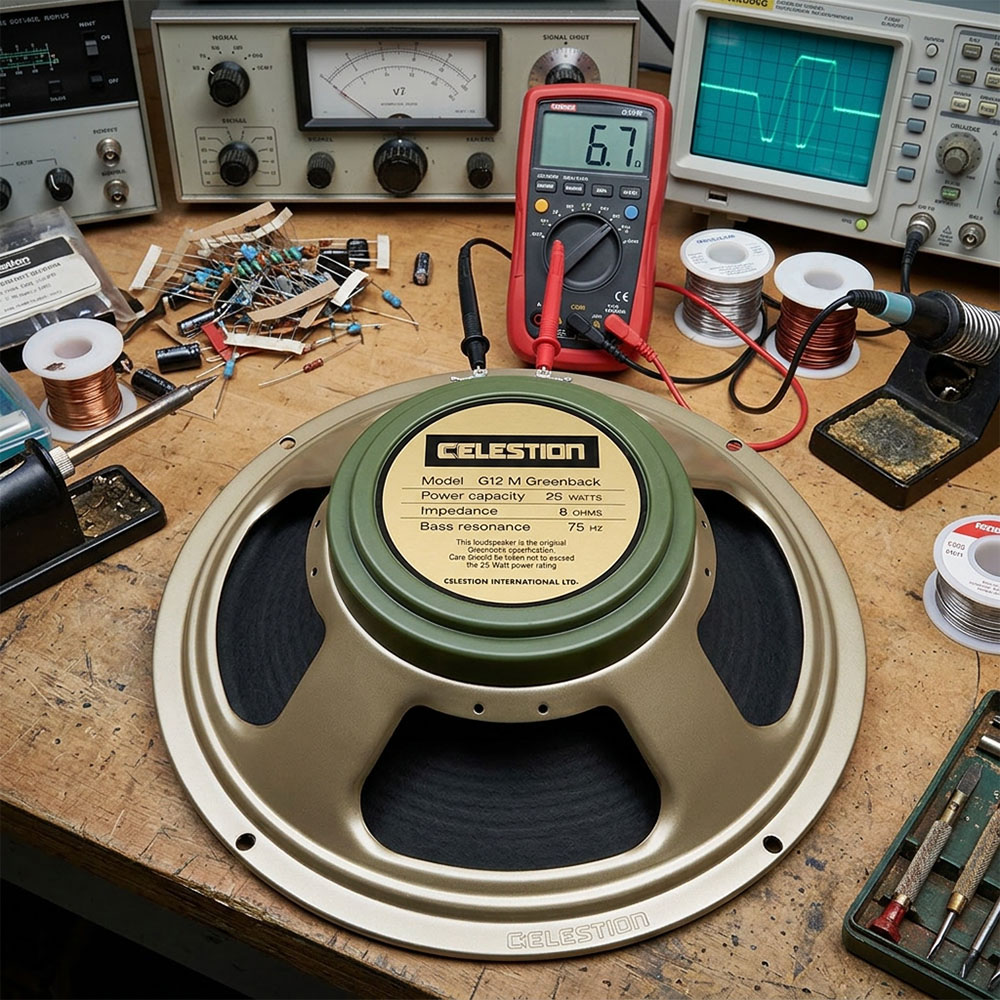
Ever put a multimeter up to check the impedance of a healthy speaker only to see a different number from what you expected? You aren’t alone. Here is the science of why it happens, what you’re really measuring and why your gear is perfectly safe.
We often get asked: “I measured my guitar speaker’s impedance but it came out different from what you said it should be. Why is that?” Don’t worry, your speaker isn’t broken! What you are running into is the fundamental difference between DC Resistance Re and AC Impedance (Z). Here’s exactly what is happening:
You measured DC Resistance, not Impedance
When you connect a standard multimeter to the speaker terminals, it sends out a direct current (DC) to measure resistance. What you read on the screen (e.g. 6.7 or 12.9Ω) is the Voice Coil DC Resistance, designated as Re. This is purely the electrical resistance of the wire wrapped around the voice coil bobbin.
Manufacturers specify Nominal Impedance
The 8 or 16Ω label on the back of the speaker is the Nominal Impedance. Loudspeakers are AC (alternating current) devices; they operate on audio signals, which are AC voltages.
Impedance is the total opposition to AC current, and it changes drastically depending on the frequency of the signal being played. Because impedance is a moving target, manufacturers choose a standardised “nominal” value (usually 4, 8, or 16Ω) to help match the speaker to an amplifier safely.
As a rule of thumb for guitar speakers, the DC resistance (Re) is typically about 75% to 85% of the nominal impedance.
The Impedance Curve
If you were to plot the speaker’s impedance across the entire audio frequency spectrum, you would see that it is almost never actually the quoted nominal impedance:
- At DC (0 Hz): The impedance equals the DC resistance measured by multimeter.
- At Resonance (fs): As you move up in frequency, you hit the speaker’s resonant frequency (usually around 55 Hz to 100 Hz for a guitar speaker). At this point, the mechanical movement of the cone generates a back-EMF (electromotive force) that fights the incoming current. The impedance will spike dramatically here, often shooting up to 60Ω or more.
- The “Trough”: Just after resonance, the curve drops back down to its lowest AC point. This minimum impedance point is usually just slightly above the DC resistance, right around 6-7Ω (for an 8Ω) speaker, 14-15Ω (for a 16Ω) speaker.
- High Frequencies (Inductance): As the frequency goes higher, the voice coil acts like an inductor. The impedance begins to rise steadily up to 20, 30, or 40+ ohms at the upper limits of the speaker’s frequency response.
A multimeter can only checked the speaker’s “resting” electrical resistance at 0 Hz. When the speaker is actually playing music connected to a guitar amp, the dynamic interaction of the voice coil moving through the magnetic field creates an AC impedance that averages out to the speaker’s nominal rating.