
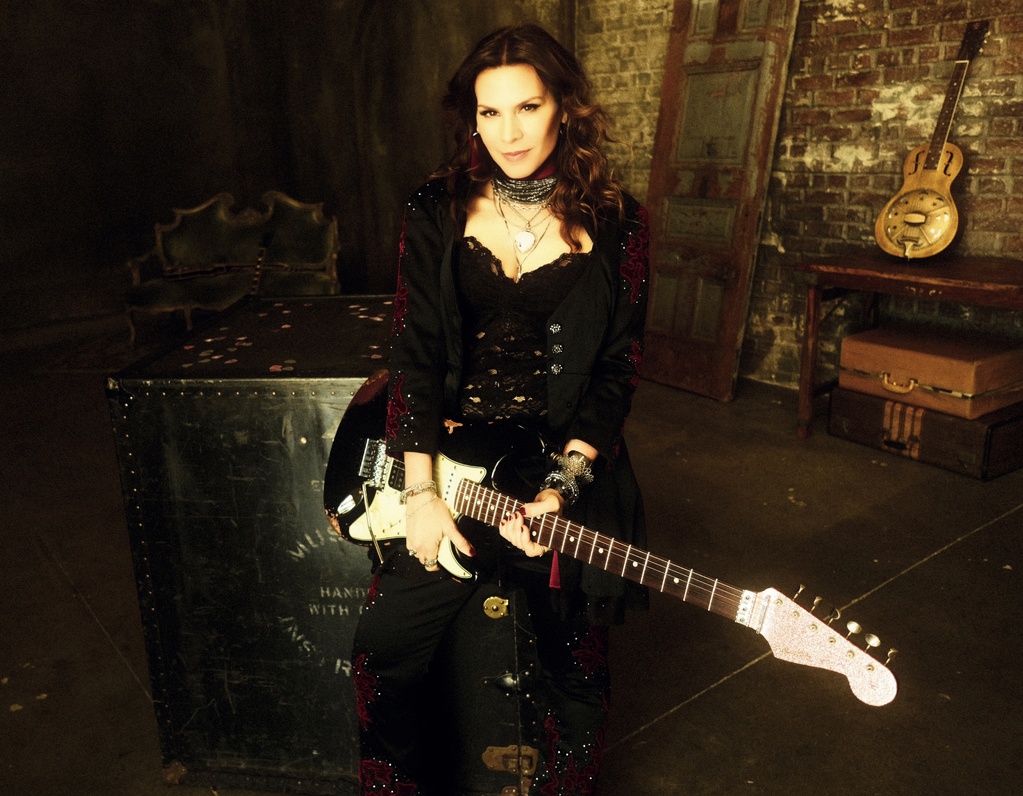
From trading a path towards a psychology PhD from UCLA for a life in rock and roll, singer-songwriter and guitarist Ali Handal has built a career entirely on her own terms with playing defined by a fierce dedication to authentic, uncompromising tone. Celestion is pleased to welcome Handal as the latest induction into our Partners in Tone programme. In our exclusive interview she discusses her musical journey, her recording process, and why she relies on the Celestion G12M Creamback for her signature sound on her new album, Slow Burn.
Let’s dive in and talk about your origin story. You were a straight-A psychology student at UCLA on your way to a PhD before deciding to become a professional musician. What was the catalyst that made you pick up the guitar and never look back?
Ultimately, I was miserable and needed a change. I had always been an aspiring guitarist, and brought all my guitars with me to LA, but I had quit playing because my perfectionism made it hard to listen to my early attempts. At the time, every guy I dated was a guitar player. Eventually, it got to the point where I realised I didn’t want to date these guys—I wanted to be these guys. So, I picked the guitar back up, committed to making it happen, and never looked back.
Which artists have influenced your sound as much as your playing and songwriting?
Because I am a singer-songwriter, a lot of my songs start on an acoustic guitar, but 95% of what I do now is on the electric guitar. When I was first starting out, I was heavily influenced by Jimmy Page, both musically and sonically. I also grew up listening to Aerosmith, and because I currently play in the Aerosmith tribute band Ragdolls, Joe Perry’s sound has become a massive influence. I continually gravitate towards those early-to-mid-70s British-inspired guitar sounds—warm, woody, and almost vocal-sounding, especially when utilising a wah pedal.
Tell us about your new album, Slow Burn.
Slow Burn just came out in October, and I am incredibly excited because I’m releasing my music on vinyl for the first time. The album is a collection of my original songs and two groovy covers, mixed by the incredible Ross Hogarth. My co-producer, Seth Atkins Horan, is a multiple Grammy-winning engineer who works for Mark Mothersbaugh of Devo, so we recorded most of the record in Mark’s studio. When we brought Ross on board to mix, it elevated everything sonically to a whole new level.
Did you do anything different in your sonic direction for this album?
We experimented with some very interesting sonic textures. Seth loves vintage gear, so we ran my guitar through an old Russian tape delay distortion box to get a really nasty, gritty sound on a few tracks. For another song, we took the tube off a talk box—which I normally only use for the Aerosmith tribute—and mic’d the direct output for a highly unique texture. And because we were at Mark Mothersbaugh’s studio, we also had access to a brilliant collection of vintage amplifiers loaded with Celestions.
Do you remember when you first became aware of Celestion?
Absolutely. My first real amplifier was a modified 50-watt Marshall head paired with a 4×12 cabinet loaded with Celestion Greenbacks. It was the amp that got away, sadly—I sold it to help fund my first record. The sound of that amp was incredibly warm and fuzzy. It wasn’t an aggressive Eddie Van Halen sound, but rather a beautiful, warm, distorted tone that I absolutely loved.
That was the first time I was truly aware of what speakers were in my cabinet and the profound impact they have. Since then, almost every single amplifier I’ve ever used has featured Celestion. I believe that Celestion is the standard. It represents the highest quality for professional rock guitarists.
Which Celestion speakers are you using today?
For a long time, I used a 2×12 cabinet loaded with Vintage 30s alongside my Fender Supersonic amp. I loved the sound, but we mostly play clubs and theatres, and without a crew of roadies, that cabinet was simply too heavy for me to carry every night. I wanted to switch to a 1×12 cabinet, so I dove into researching gear. All my research pointed directly to the Celestion G12M-65 Creamback. I put one into a lightweight, angled Mojotone Slammins cabinet, and it sounds phenomenal while being incredibly easy to transport.
What else do you use to get your tone? What guitars and pedals are you playing?
I’m very partial to a couple of Custom Shop Les Pauls, though I prefer the neck profile from the Classic series. Recently, I have also been working with Venus Guitars, which make incredibly lightweight and ergonomic instruments that are a joy to play and offer a very different sonic character. I also use a beautiful Custom Shop Stratocaster with a single humbucker, and a Dan Armstrong guitar specifically for the song “Draw the Line” with the Aerosmith tribute, which features an incredible, totally unique pickup.
On my pedalboard, I rely on an Archer pedal, which is a Klon clone—essential for that Joe Perry tone. I also absolutely love my Exotic Wah; it is a three-quarter scale pedal that lets you dial in the exact sweep and tone you want.
You wrote a book called Guitar for Girls. What is your most important piece of practical advice for a beginner who may be intimidated by the guitar or the gear world?
Hal Leonard actually chose that title; I prefer to think of it as “Guitar for Singer-Songwriters,” though I am a huge advocate for women expressing themselves through music. My best advice is simply: do not give up. You have to be willing to suck at the beginning.
Today, learning is easier than ever. You can use YouTube to find phenomenal teachers, and you can use AI to learn about technology. If you’re a beginner and feel embarrassed to ask someone at a guitar shop how a pedal works, or how to properly string your guitar, you can just ask AI. It removes the intimidation factor from learning about your gear.
After touring internationally and mastering your craft, what is the one tone secret you would share from your journey?
Tone ultimately originates from your hands and your body, rather than just the gear. It’s magical how someone like Eddie Van Halen could pick up a cheap acoustic guitar and still sound exactly like himself.
That being said, you must bring yourself to the gear and learn how to use it. When I asked top guitar techs what I needed to replicate Joe Perry’s tone, they told me it was more about knowing how to properly use a basic Strat, Les Paul, and a Tube Screamer than having 45 guitars on tour. If you learn what every knob does, you can get a remarkably wide array of tones out of a simple setup. My advice: Learn your gear, and find a speaker—like a Celestion—that perfectly reproduces and accentuates your tone.
Do you have a personal philosophy about music?
For me, music is a spiritual endeavour. It’s a way to relate to the world and connect with other people. In this digital age where people are so separated, I strongly encourage everyone to experience live music. There is something truly magical about it, whether it’s going to a concert at a small club or just sitting in a living room improvising harmonies with your family. You don’t have to be a professional to participate; you just have to enjoy it.
Learn more about Ali Handal at https://www.alihandal.com/ and listen to her new album, Slow Burn on all major streaming platforms.
##
