
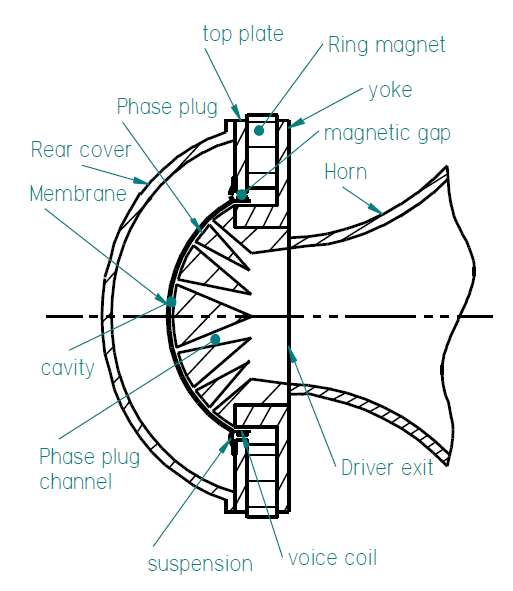
Ever wondered how Maximum Modal Suppression works, reducing unwanted HF distortion for our flagship compression drivers by changing the size and positioning of the annular slots in the phase plug? Here’s the official word, as documented in the 123rd AES Convention Paper by Dodd & Oclee-Brown. Full paper attached.
A New Methodology for the Acoustic Design of Compression Driver Phase-Plugs with Concentric Annular Channels
ABSTRACT
In compression drivers a large membrane is coupled to a small horn throat resulting in high efficiency. For this efficiency to be maintained to high frequencies the volume of the resulting cavity, between horn and membrane, must be kept small. Early workers devised a phase-plug to fill most of the cavity volume and connect membrane to horn throat with concentric annular channels of equal length to avoid destructive interference.
Later work, representing the cavity as a flat disc, describes a method of calculating the positions and areas of these annular channels where they exit the cavity, giving least modal excitation, thus avoiding undesirable response irregularities.
In this paper the result of applying both the equal path-length and modal approaches to a phase-plug with concentric annular channels coupled to a cavity shaped as a flat disc is further explored. The assumption that the cavity may be represented as a flat disc is investigated by comparing its behavior with that of an axially vibrating rigid spherical cap radiating into a curved cavity.
It is demonstrated that channel arrangements derived for a flat disc are not optimum for use in a typical compression driver with a curved cavity. A new methodology for calculating the channel positions and areas giving least modal excitation is described. The impact of the new approach will be illustrated with a practical design.
DISCUSSION
This work, by necessity rather than intention, has resulted in an interesting counterpoint of analytical and computational analysis. FEM used as a tool to get at the behaviour by splitting the problem/design into abstract experiments. Analytical analysis helps to confirm the physics and that the optimum solution is reached. It also makes it possible to generalize (for example for many angles).
For some cases with too many degrees of freedom there is no alternative. FEM can, of course, go further and attempt to find solutions for more complex cases such as optimum positions and widths of channels when the membrane is not rigid or cavity and membrane shapes that cannot be described by separable coordinate systems. Computational analysis is not, however, required to understand that the cylindrical representation is not a sufficient description of the problem considered.
Though, conversely, the analytical analysis of the spherical case is complicated by the presence of Legendre functions of non-integer order and integrals of these functions. Issues dealing with such expressions are neatly sidestepped as happily we are able to insert a little numerical analysis when other routes fail. The Eigenfunctions used in the analysis are, in fact, calculated with FEM models.
The traditional analytical analysis approach of reducing a problem into easy-to-understand simply behaving parts is a truly powerful way of applying FEM modelling. The parts can be analysed and conquered individually. Assumptions can be checked and the parts re-assembled after they are understood.
CONCLUSIONS
The equal path-length approach does not take into account the modal behaviour and cannot be expected to produce optimum results in every case. Smith’s methodology is very successful with the flat disc shaped cavity giving almost total suppression of the modes.
However, when applied to a cavity shaped like a spherical cap Smith’s technique does not produce such good results; while for the planar membrane, the channels alone excite the modes; the spherical cap membrane excites the modes even in the absence of channels.
In this paper it is demonstrated that the correct choice of channel widths and positions can compensate for the normal volume velocity variation of the membrane and avoid exciting modes.

