
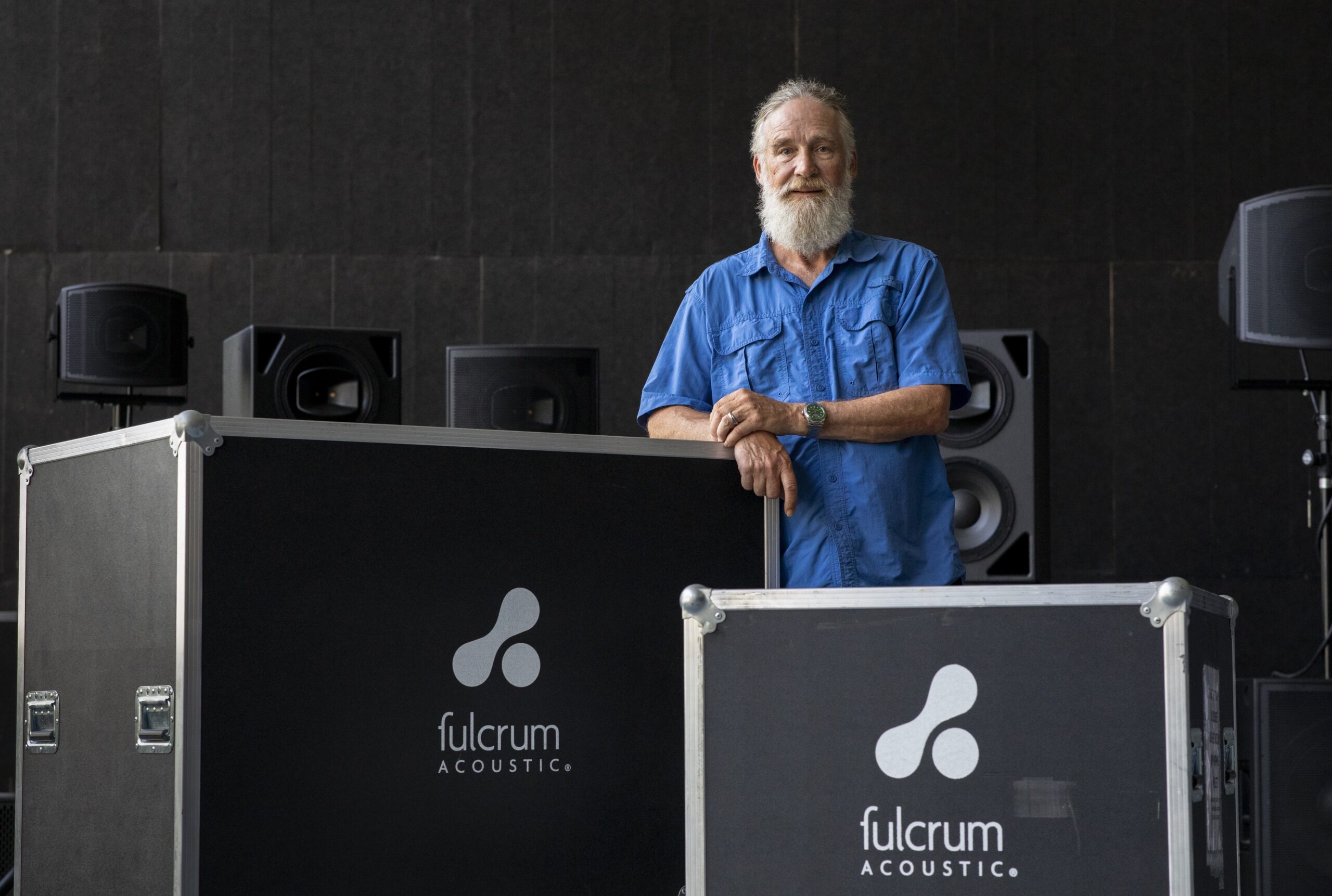
David Gunness is a highly respected American audio engineer and inventor, renowned for his extensive work in loudspeaker design and digital signal processing (DSP). After spending 11 years at Electro-Voice and another 12 years at Eastern Acoustic Works (EAW), where he developed his groundbreaking “Gunness Focusing” technology, he co-founded Fulcrum Acoustic in 2008 alongside Stephen Siegel.
Throughout his career, Gunness has pioneered high-output professional loudspeakers, advanced coaxial designs, and passive cardioid technology. Today, he serves as the Senior Vice President of Engineering at Fulcrum Acoustic, continuing to push the boundaries of modern sound reinforcement.
As part of The Celestion Interview Series, we sat down with Dave Gunness to discuss his early career, his most significant technological innovations, the philosophy behind Fulcrum Acoustic, and the music that inspires him.
What is your favourite album of all time and why?
My favourite is James Taylor’s Mudslide Slim. It actually belonged to my sister when I was a kid, and it is completely unplayable now because I played it so much that I wore deep grooves into the vinyl. I am not just a loudspeaker engineer; I am also a musician. In my early days as an aspiring musician, I was constantly trying to figure out how to make the kinds of sounds James Taylor made, so that album was incredibly influential to me.
What was the thing that got you started in the music industry?
It started because I was a gigging college musician who couldn’t afford a proper PA system. I decided to build my own speakers so I could play out. I bought some plywood, used a table saw in my basement, and built my first speakers using Radio Shack components. I carried them around and used them to play all my gigs in college.
How did you learn to make loudspeakers?
I initially found enough information to make a basic second-order passive crossover for a two-way speaker, but I knew it didn’t work perfectly and could be improved. That curiosity led me to spend many hours poring through Audio Engineering Society (AES) journals in my college library. I was also fortunate that a tenured professor at the university, Richard Greiner, offered a couple of audio-specific courses. I took those classes, which gave me a rare opportunity to earn a university degree that included a significant amount of audio technology.
How did you get your start in the business, and what is your current position?
When I graduated from university, I interviewed with several companies and accepted a job as a product design engineer with Electro-Voice. Interestingly, on my very first day of work, I was handed two highly important projects. I hit one out of the park, but I struggled with the other. My project management wasn’t great, and I didn’t realise I could ask for a larger tooling budget to make a proper U-bracket. It also featured a completely round horn, and I learned the hard way that a round horn is not a good idea. I learned so much from that early project, and it directly influenced the 30 or 40 coaxial horns I have designed since at companies like EV, EAW, and now Fulcrum. Today, I am Co-Owner and Senior Vice President of Engineering at Fulcrum Acoustic which we founded in 2008.
Fulcrum Acoustic is renowned in the industry. In your viewpoint, what is the main reason for that?
It comes down to consistently excellent audio quality. We currently have around 130 products in our catalogue, the majority of them were designed by me and voiced with Rich Frembes’ welcomed criticism and ear. While we have more people involved in the design process now, the voicings are still heavily influenced by Rich and myself.
Because we work so closely together as a team, the voicing of our 30-inch coaxial horns sound identical to our 5-inch fill speakers. That consistency makes it incredibly easy for our customers to integrate large systems because they aren’t fighting with loudspeakers that inherently sound different from one another.
Which product or technology do you consider your company’s most innovative?
The underpinning of our company is our pattern control coaxes. We offer five different patterns in a 12-inch coax, a 15-inch coax, and in dual 12 and dual 15 formats. Bizarrely, even 17 years after we introduced them, nobody else in the industry has stepped up to match it. We also have our AHC series, which features an innovative, high-sensitivity re-entrant horn designed for 80 Hz and up.
However, the technology driving our most recent growth is our passive cardioid function. I set out to figure out if a passive cardioid speaker was possible, and it worked. Today, we have an entire range of passive cardioid subwoofers, mains, and fill speakers. If you place our CCX passive cardioid speaker halfway down a church, it suppresses the low frequencies from travelling backwards into the front rows; it only fills the exact area it is intended to fill. Today, roughly 40% of our loudspeakers are passive cardioids.
What is the accomplishment that you are most proud of?
Founding Fulcrum Acoustic is absolutely my proudest accomplishment. In terms of individual speaker designs, the KF900—which I designed prior to founding Fulcrum—was my magnum opus. It essentially proved to the world that large-format digital steering was possible.
Can you talk about your company culture and your philosophy for leading the team?
It is deceptively simple: be the company your customers need you to be. By the time we started Fulcrum, I was 24 years into my career and had seen things done both well and badly. Your customers need a high-quality, great-sounding product with a reasonable lead time, on-time delivery, and solid support before and after the sale. If you partner with your customers and help them succeed, your own sales will grow. Your greatest opportunity as a loudspeaker manufacturer is to be a hero. When you bail your customers out of a tough situation, you’ve got a customer for life.
How is your company poised for the future?
We are poised for the future by continuing to be exactly what our customers need us to be. That approach has brought us to this point, and as the old saying goes, “Ya dance with the girl that brung ya.” (sic)
What do you think has been the single most important technological achievement in the pro audio industry?
The rapidly expanding capabilities of digital signal processing (DSP) and the ability to use it to make loudspeakers sound significantly better. I developed processing advancements that were initially marketed as Gunness Focusing under EAW, with Fulcrum Acoustic’s version marketed as Temporal Equalization™, or TQ. That shift in DSP technology has been the biggest change in the industry since I entered it in 1984. When we started Fulcrum, we leveraged that technological shift. We never set out to make a loudspeaker intended to be plugged directly into an amplifier without DSP. Every loudspeaker we have ever made requires DSP, which allows us to maintain an incredibly high level of sound quality and consistency.
What music are you listening to currently?
I play in a band, and I mostly listen to a Spotify playlist containing all the songs we perform. It is completely all over the map, ranging from sea shanties to modern pop and folk. We actually don’t have a drummer; instead, we mix up all different combinations of instruments. I sing and play the guitar, bass, mandolin, and harmonica. We love keeping it fresh, and the audience never knows what is coming next.
##