
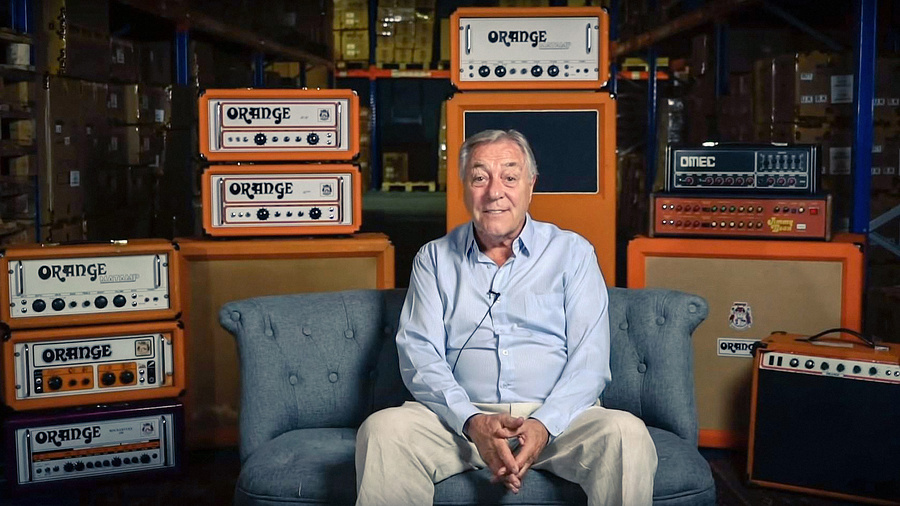
Since 1968, Orange Amplifiers has been a cornerstone of British guitar tone, instantly recognisable by its vivid colour, bold design, and unmistakable sound. Founded by Cliff Cooper in a small shop in London’s West End, the brand has grown from its psychedelic origins into a global amplification powerhouse, from early success on the stages of legendary artists like Peter Green’s Fleetwood Mac to recent product collaborations with Ed Sheeran. In this exclusive interview for the Celestion PA Legends series, we sat down with Cliff Cooper to discuss the fascinating origins of Orange, his groundbreaking (and ahead-of-its-time) amplifier designs, his leadership philosophy, and his enduring love for analogue sound.
What is your favourite album of all time, and why?
I have been listening to music for almost 70 years, and there are so many different genres that I enjoy, so choosing just one is very difficult. However, if I had to pick, it would be The Beatles’ Sgt. Pepper’s Lonely Hearts Club Band. The audio, the acoustics, and the actual production on that album are incredibly clever and simply beautiful.
What was the moment you knew you wanted to work with audio?
My first job was as a television engineer, which gave me a strong background in electronics. Around that time, I built a small recording studio at home and played in a band called The Millionaires. We actually had a number 12 hit record produced by the legendary Joe Meek. Unfortunately, he passed away shortly after our first record, which effectively ended our recording career. From there, I concentrated entirely on my love of music, recording, and electronics, which ultimately set me on the path to creating Orange.
Tell us the story about how Orange got off the ground.
I was looking to build a professional recording studio and found a derelict shop with inexpensive rent in London’s West End. We set up the studio in the basement, but it took a while to take off. To draw attention and pay the bills, we painted the shop bright orange—which the neighbours weren’t very happy about! In those days, most cars and amplifiers were black or grey, but it was the hippie era, and our shop was in tune with what was happening.
We were perfectly located right in the heart of “the music walk” between Denmark Street and Shaftesbury Avenue where all the music shops were. We started selling second-hand equipment because major brands wouldn’t supply a new shop like ours, and bands preferred beaten-up gear over new, shiny instruments anyway. Eventually, I needed an amplifier of my own to sell, so I designed one. We were incredibly lucky; the first band to use our amplifiers was Peter Green’s Fleetwood Mac. They recorded their number-one hit single Albatross with our gear, and their US tour really gave Orange lift-off. Soon after, Stevie Wonder tracked his clavinet parts for Superstition using our amplifiers. Suddenly, we couldn’t build the equipment fast enough.
During those years, I also ran a booking agency and management company. I managed John Miles, the band Smokie, and even a famous motorcycle jumper named Eddie Kidd, who jumped cars and buses and rivalled Evel Knievel. It has been quite a journey, and today we are a global company with manufacturing operations in the UK, the US, and China.
You had a musical instrument shop, a booking agency, and a recording studio. How did that wide background influence Orange?
Having that wide experience helped us truly understand what people in the music business wanted from their equipment. Through the management agency and the studio, we met countless musicians and received direct feedback. When we were designing different models of amplifiers, we understood exactly what the bands needed, which helped establish us as makers of amplifiers that simply sounded right.
Orange is renowned in the industry. In your viewpoint, why is there such a love for the brand?
I think it is because our customer service is second to none, and our amplifiers are built to last. Furthermore, we champion analogue sound, which, in my opinion, remains superior to digital. Most importantly, we genuinely care about our customers. I have to say, this is a characteristic we share with Celestion—they have always made incredible speakers and are a lovely, caring company to work with.
Which product, past or present, do you consider your company’s most innovative?
In 1975, we invented the world’s first digitally programmable amplifier, which we called the OMEC Digital (Orange Musical and Electrical Company). It allowed musicians to key in and instantly recall different sounds. Because it required about 50 transistors, we desperately needed a microchip. Unfortunately, the bank managers in those days were very traditional. They took one look at our long hair and hippie-ish appearance and refused to lend us the money to make it commercially viable. We produced about a dozen of them and had interest from all over the world, but we were losing money on them and had to drop the project. However, it paved the way for the digital amplifiers that are so universal today.
Can you talk a bit about your recent collaboration with Ed Sheeran?
We had been speaking with Ed Sheeran’s team for quite a while, and we collaborated on a range of high-quality acoustic busker amplifiers. The flagship ES100 100-watt model sounds absolutely amazing and uses the latest Celestion Neodymium speakers and tweeters. There is also a medium busker amp, and a small acoustic amplifier with Bluetooth and reverb that is perfect for practising at home.
Ed is incredibly passionate about encouraging people to learn instruments and get into music, and these amplifiers are perfect for that. His music is universal and crosses all sorts of boundaries, much like The Beatles did in the early days. He is a really nice guy and has been fantastic to work with.
What is the accomplishment you are most proud of from your career?
I am most proud that Orange has stuck to what we believe in, rather than simply taking the most profitable path. We only produce things that we like ourselves. When you play through an amplifier, it is like driving a car—you become one with it. You just know when the sound and the feel are right. Sticking to that standard is one of the main reasons we have been so successful.
Can you talk about your company culture and your philosophy as a leader?
We are a global company, so we have to communicate effectively and work seamlessly as a team. If you ask me the one defining trait of our company, it is that we care. Caring is the most important thing, not just in business, but in life. Everyone within the company shares that team spirit, and it creates a lovely, warm feeling when dealing with our people all over the world.
How is Orange poised for the future?
The future is moving incredibly quickly, largely due to Artificial Intelligence. AI is changing everything, from how music is written to how we isolate instruments on a track to help musicians learn. We are actively embracing AI; in fact, we currently have digital products in development that utilise it. The whole industry is undergoing a massive shift, and Orange is adapting to stay at the forefront while remaining true to our roots.
Finally, what music are you enjoying listening to these days?
When I get the time, I love listening to vinyl records. I really love rock and metal bands like Rush and Slipknot, but I also enjoy Marcus King—I think he is a great guitarist. I will flip through my record collection and play everything from country to classical. I truly enjoy music right across the board.
##