From Touring Titan to TV Tone Architect: Celestion Empowers the Decades-Long Musical Journey of Devin Powers

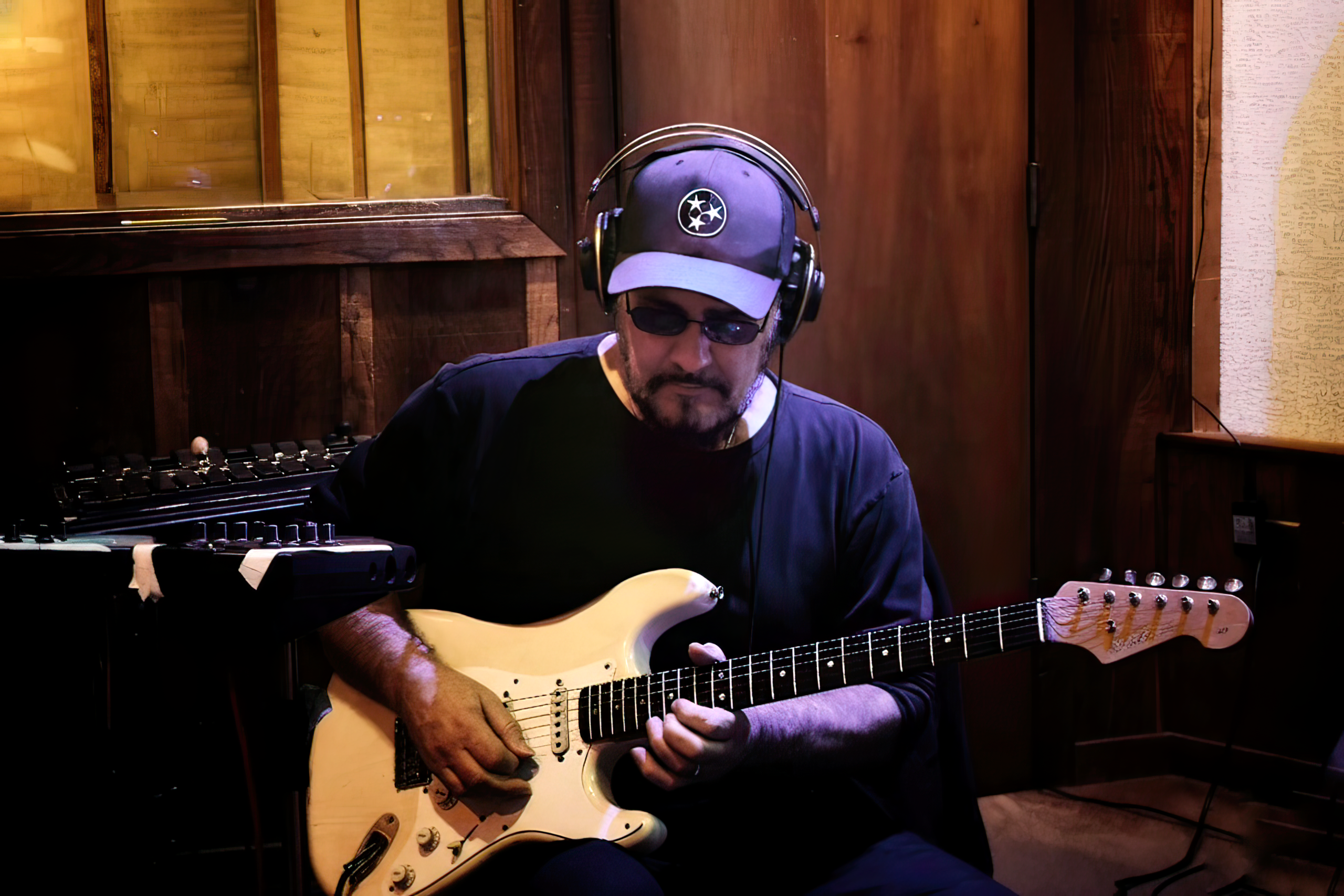
Devin Powers, a musical force for over 45 years, has navigated a career path few could claim—from headlining gigs in the San Francisco Bay Area and collaborating with rock legends like John Entwistle to becoming one of the most decorated composers in history. With credits including the hit TV series Blind Date, the Bachelor franchise, and You Vs Wild (for which he received an Emmy) and song placements in films including Wakanda Forever and Wicked, the foundation of his signature sound has remained constant: Celestion loudspeakers, most notably the Alnico Blue, Alnico Gold, and the G12 EVH.

Can you share your origin story? How did you get your start as a guitar player?
I grew up in Redwood City, California, and came from a working-class family. My father was a war hero who stormed the beaches at Normandy and brought a large hollow-body acoustic guitar back from Europe, which was my first exposure to music. I started learning songs around four or five years old. By sixth grade, I got my first electric guitar, a broken SG that my dad had re-glued because we were poor. I worked constantly after school to buy gear, eventually acquiring a nice Les Paul and a Marshall stack. By my mid-teens, I was getting mentored by Neal Schon and jamming with local legends in the San Francisco Bay Area like the guys from Tower of Power,
My high school band, The Kids, began opening for groups like Journey, The Tubes, and Greg Kihn, eventually headlining gigs. We landed a worldwide 7-Up commercial, which helped us buy better amps, including my first Hiwatt amp. When we returned from a 60-day, sold out tour of Japan in 1983, my bandmates were ready for regular jobs, but I knew I was a lifer.

Your career then famously intersected John Entwistle. How did that opportunity come about?
After my rock band failed to get signed following an Atlantic Records development deal (due to our manager leaving to work with Sammy Hagar and Van Halen), my musical godfather took my demo tape to England. I later got a phone call from a heavily accented voice saying, “It’s John from The Who”. I didn’t believe it at first, but he had five of my songs and wanted to record them for his new band, THE ROCK.
Walking into his 140-acre estate in Gloucestershire was one of the most surreal moments of my life. We recorded, mixed, and mastered an album, even signed a deal with Warner Bros, but the record was shelved one day after a call from Pete Townsend. John’s manager explained that The Who was getting back together for a reunion tour, and they would make more money off one night of Who T-shirts sales than they would from ten Entwistle albums. I later toured with Lee Rocker of The Stray Cats before my band, The Vents, signed with Universal Records in 1998.

How did you pivot from being a touring rock musician to composing for TV?
A friend I was producing connected me with a team looking for a “rock guy” to do music for TV shows. Turns out, they were huge Who fans and bonded with me over playing with John Entwistle. They hired me for a new unscripted show called Blind Date, allowing me to keep all my publishing and writing, and paying me a significant weekly salary. I brought in my gear—including a Celestion-loaded Marshall stack—and started writing. I did 500 pieces of music for Blind Date before the first Christmas.
When I received my first ASCAP check in January, I called my mom and told her I wasn’t quitting—I realized I could do this. I ended up doing 1,500 episodes of Blind Date and many other shows, winning the ASCAP award for “Most Performed Television Underscore” for several years. My heavy rock music style was a new thing in TV, differentiating me from traditional library music.

Your composing business grew rapidly. How did you take it to the next level?
Around year four or five of my TV career, I ran into Hans Zimmer at the ASCAP Awards red carpet. I asked him how he managed to score so many films annually. He asked the size of my team, and when I admitted I was doing it all myself, he essentially told me that approach would “kill me” and I couldn’t have a long career doing that.
He advised me to find people who could “clone” my style and assign them different shows, while I remained the lead composer, providing the themes and vibe. The next day, I began hiring rock musician friends and training them. Today, I lead a team of about nine master composers. This advice was instrumental in allowing me to continue composing, leading to 27 years in TV and scoring massive shows like Naked & Afraid for Discovery. Currently, I reside in Nashville, focusing on cutting country rock, blues rock, and heavy rock records while still running Powers Music Group.

When did you first become aware of Celestion speakers?
I took the back off my first 4×12 Marshall cab and saw the name on the speakers. I soon realized that Marshalls often contained different types of Celestions.
I have been a Celestion player since I was 18 years old and I have remained a Celestion player because the speakers are the truest to a guitar’s sound. When I play through a Celestion, I can clearly hear the difference between a Stratocaster, a Les Paul Jr., and a Les Paul Custom.

Which specific Celestion drivers are your go-to?
I have a large collection of Celestion speakers loaded into various cabinets in my studio. I use a 4×12 cabinet loaded with Alnico Blues at the bottom and Reds at the top, along with cabinets featuring Creams and Golds. If I am looking for a jangly, compressed sound, similar to Tom Petty, I often use the Alnico Gold in my Silent Sister isolation cabinet. For more of a Jimi Hendrix-type bite, I might use 30-watt drivers.

My two favorite Celestion drivers are the Alnico Blue and the 20-watt Greenback (which is now the G12 EVH). They are in a dead heat, depending on what I am trying to achieve. I love the EVH with my 100-watt Wizard head. It’s perfection. This combination allows the tone to break up and sustain when the volume is all the way up for solos but remain distinct and clear when I turn the volume down.

What is your overall approach to achieving great guitar tones?
My philosophy for tone starts with getting the sound right out of the gate. I almost always use Neve EQs on the microphones (often blending a Royer 121 with an SM58). I do not use compression on guitar when tracking because a good speaker already compresses the signal. A critical element for my preferred tone is rolling the low end off the guitar and using treble bleeds on my volume knobs. This is essential because, on a Les Paul, turning down the volume often results in “mud”. By using treble bleeds and a specific capacitor (like an .015) for the “woman tone” on the tone knob, I can roll back the volume during a solo (usually to three or four) to cut off the high end, making the note speak more like a horn.
In my opinion, Celestion gives every guitar player the best tone possible. It facilitates a magical interplay between the artist, the amplifier, and the tone of the speaker.

For more information on Devin Powers and to hear examples of his music visit Powers Music Group.
Production Engineer

We’re looking for a skilled and experienced Production Engineer to work with our production and R&D teams. You will be helping implement production processes and procedures and leading productivity improvements with project-based activities. This will  include new product introduction and manufacturing cell design to reduce waste, improve quality and safety, and reduce operating costs. Work could take place on many phases or sub-tasks of projects, or entire projects, with results having a real impact on project completion.

The Person:

  • Excellent verbal and written communication skills
  • Highly organised with the ability to multitask
  • Diligent and analytical, with a good eye for detail
  • Enthusiastic, with the ability to motivate
  • Understanding of manufacturing processes
  • Comfortable with  engineering, scientific and other technical information
  • Strong problem-solving skills and a logical approach
  • Familiarity with current Health and Safety practices
  • Ability to train the work group and lead teams within the work group

Duties to include:

  • Support manufacturing on a daily basis
  • Work alongside Research & Development team on new product introductions
  • Plan and schedule PPM (planned preventative maintenance).
  • Liaise with other engineers to develop improvement plans where necessary.
  • Develop and draught improved production processes.
  • Diagnose problems in the production line and provide recommendations and training.
  • Establish safety procedures and protocols that take workers well-being into account.
  • Liaise with research and development staff to ensure seamless transition
  • Design new systems, equipment and processes for the introduction of future new products, or the improvement of existing ones
  • Plan and organise working areas and equipment

Experience required:

  • Higher Diploma in Engineering
  • Production line set up
  • Effective communication at all levels
  • Use of MRP/ERP systems

Advantageous:

  • Automation/Robotics
  • CAD
  • Understands 5S methodology
  • Understands ISO9001/2015 requirements

In addition to a competitive salary, we offer the following benefits:

  • Enhanced sick pay
  • Employee Assistance Programme
  • Enhanced pension
  • Free onsite parking
  • Employee discount
  • Free tea and coffee

Here at Celestion we know it’s our people that make our business great, we work hard as a team and do our best to ensure our staff feel supported and valued. Please note, due to the location of our office you will ideally need to have your own transport.

Job Types: Full-time, Permanent.

Salary: Competitive, plus discretionary annual bonus.

To apply, send your CV and a covering letter to: Human Resources, Celestion, Claydon Business Park, Great Blakenham, Ipswich IP6 0NL, UK or via email.

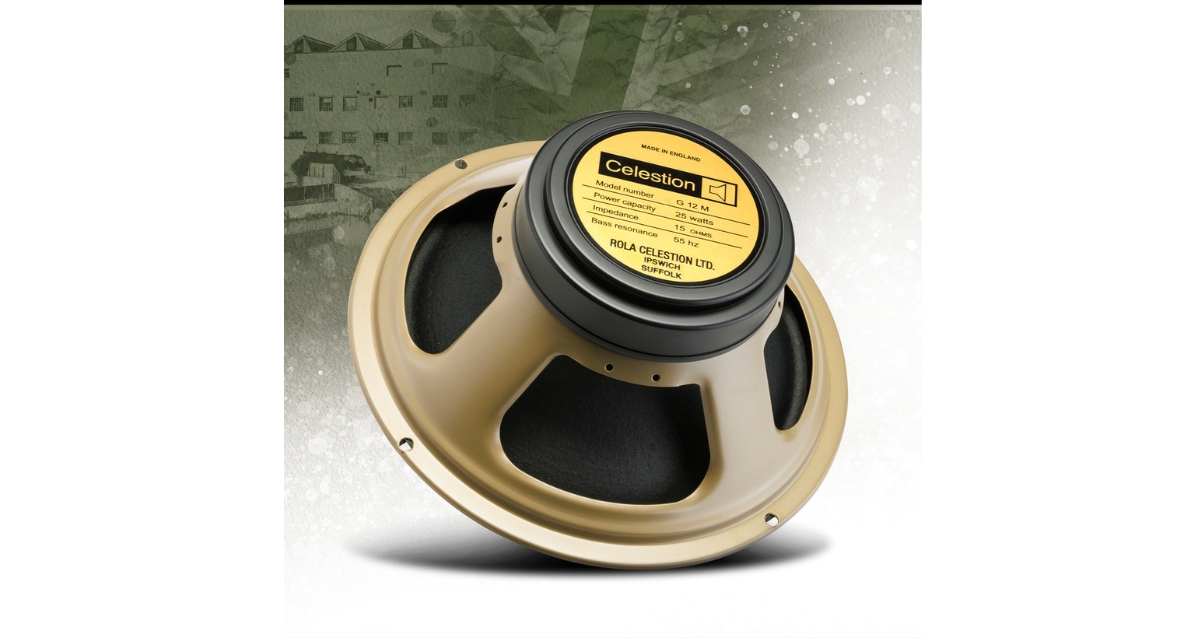
Celestion’s Legendary Heritage Series Returns with New G12M (55) “Blackback” at Winter NAMM 2026

Anaheim, CA (January 21, 2026)  — At this year’s Winter NAMM 2026, Celestion, the premier manufacturer of guitar and bass loudspeakers, is proud to announce the return of the celebrated Heritage Series guitar speaker line including the G12H (55), G12H (75), and G12-65, alongside the debut of the “Blackback” edition of the long-sought-after G12M (55). The Heritage Series, back by popular demand, brings several of the company’s most beloved classic drivers, coveted by collectors and tone purists, to recapture the sonic qualities of the era.

The Celestion Heritage process identifies the most desirable version of a driver from a specific point in time and sets about a painstaking process of regressing the speaker’s development to its inception. Using original blueprints and material specifications, Celestion sound engineers have ensured magnet assemblies and coil formers are produced exactly as they once were. In addition, they have reformulated adhesives and edge treatments that are no longer commercially available. Finally, authentic labels have been used to bring these exquisite old speakers back to life.

One of the stars of this year’s NAMM exhibit is the G12M (55) “Blackback” (originally released as the T1511). While Celestion’s earliest popular ceramic speakers featured green plastic cans, the company transitioned to a black can in the early 1970s—a change that has taken on great significance for tone enthusiasts. This G12M version with a 55Hz bass cone has been inextricably linked to players like Paul Kossoff of Free, whose famously sweet sustain defined an era. Rated at 25 watts with a sensitivity of 96dB, the G12M (55) delivers the punch, sparkle, and singing midrange that many consider the very essence of Celestion tone.

Joining the G12M (55) are the returning Heritage Series G12H (55) and G12H (75). These faithful re-creations capture the unmistakable mojo of late 60s rock guitar tones, both famously powering the rigs of legends like Jimi Hendrix. The G12H (55) features a 55c/s bass cone known for thick, syrupy tones and a deep, growling back end—a definitive choice for towering 4×12 stacks. The G12H (75) employs a 75c/s lead  cone, providing a tighter bottom end and punchy upper-midrange for those seeking different tonal balance. Both G12H models feature a 30-watt power rating and 100dB sensitivity.

Also now found under the Heritage Series umbrella is the currently available G12-65. A firm favourite of hard rock players in the early 80s, this 65-watt driver features a precisely tuned midrange and crisp, defined top-end that delivers an aggressive crunch capable of punching through any mix.

“Celestion fans have been asking us to re-introduce the drivers found in the new Heritage Series for years, and no stone was left unturned in pursuit of their original sound,” said Paul Cork, Celestion’s Head of Engineering. “We poured through our large archive of drawings, blueprints, and parts-lists; we called upon the expertise of Celestion engineers past and present, and spent hundreds of hours in our listening room, critically auditioning the original speakers against the Heritage models in development, before we were comfortable in proceeding with production.”

More information on the Heritage Series is available on the Celestion website.

Visit Celestion at the 2026 Winter NAMM Show at the Anaheim Convention Center, Booth #6602, January 22-24, 2026.

About Celestion

With worldwide headquarters in Ipswich, England, Celestion design, develop and manufacture high-quality professional audio loudspeakers and compression drivers for sound reinforcement, as well as premium guitar and bass guitar loudspeakers. These world-renowned speakers are used onstage and in clubs, theatres and other venues the world over. With more than 100 years of success, the company continues to offer the latest technologies and innovations in the world of loudspeakers. celestion.com

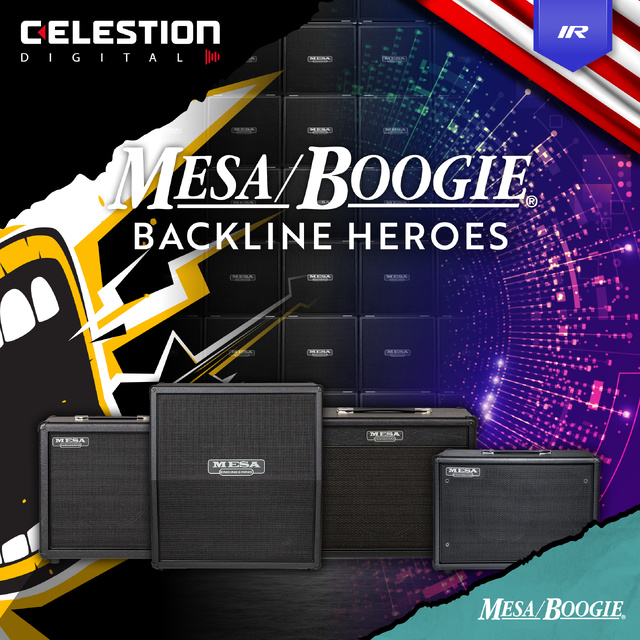
Celestion Introduces the Iconic Mesa/Boogie Impulse Response Collection as part of its extensive Backline Heroes Series

Ipswich, UK (January 7, 2025) — Celestion, the premier designer and manufacturer of guitar and bass loudspeakers, well-known as the “Voice of Rock and Roll” behind many of music’s most memorable guitar performances, is proud to introduce the Mesa/Boogie Impulse Response (IR) Collection, the newest addition to the acclaimed Backline Heroes series. This new collection meticulously captures the unique tones of Mesa/Boogie’s legendary and extensive range of speaker cabinets and provides them in a digital impulse response format available for audition and download at celestionplus.com.

The Mesa/Boogie IR collection features some of the most iconic guitar tones in rock and metal history, commonly favoured by those seeking a heavy sound with a significant bottom end. However, the collection is versatile, encompassing the soulful, vintage magic of the Lone Star cabs, the low-end fullness and thump of the classic Rectifier cabinets, and the monstrous punch of the Widebody.

Celestion’s sound engineers have faithfully captured the distinctive tones of 14 distinct Mesa/Boogie cabinet types, each loaded with carefully selected Celestion speakers—43 in total, both factory standard and common mods—to complement the cabinet and ensure maximum tonal variety. The complete collection provides 108 distinct speaker/cabinet combinations, allowing users to find their perfect tonal flavour.

The impulse responses are available individually, together as the complete Everything Pack, or in four carefully curated multi-IR collections:

  • Fat Pack: Captures Mesa/Boogie’s Widebody™ and Thiele 1×12 cabs, created to deliver fat tones and an outsized low-end punch.
  • 4×12 Pack: Features three legendary 4×12 Rectifier® cabinets, providing essential metal tones with thundering low-end punch and articulate high-end.
  • Recto Pack: Includes the Recto 2×12 and 2×12 extension cabs, designed for use with Rectifier and Mini Rectifier® heads. Delivers high-gain aggression and full-bodied Mesa/Boogie tone.
  • Lone Star® Pack: Features all the Lone Star 1×12 and 2×12 extension cabs, emphasizing punch and projection combined with vintage warmth—making it perfect for country and Americana styles.

Celestion captured these cabinets using the same painstaking recording techniques applied to their principal range of IRs. Each cabinet impulse response was accurately recorded with studio-standard microphones, including the Royer R-121 ribbon, Shure SM57, and Sennheiser MD421. This detailed process offers 18 distinct tones for each cabinet and speaker combination, including six microphone positions and mic mix options. Open-back cabinets were captured with an additional rear mic position.

Paired with a DAW and IR loader plug-in, modeling amp hardware, or load box, the Celestion Mesa/Boogie Impulse Response Collection provides authentic tone alongside lively and dynamic response, all without introducing latency. These benefits create a playing experience that is as credible as any speaker can achieve, but with real-world performance that is predictable and reliable in today’s most demanding recording and performance applications.

The complete Mesa/Boogie Backline Heroes collection is available now  for audition and download now at celestionplus.com.

Visit Celestion at the 2026 Winter NAMM Show at the Anaheim Convention Center at booth 6602, January 22-24, 2026.

 About Celestion Digital

The introduction of authentic Celestion Impulse Responses represented the company’s forward step in making their celebrated speaker tones available as digital downloads. Celestion IRs capture the essential behavior of a speaker in a particular cabinet in the specific space in which it was recorded, including the frequency and phase response of single drivers as well as the interaction of multiple speakers. They offer significant benefits in both recording and live production, enabling the desired tone to be precisely and consistently reproduced regardless of the recording or live sound environment. Explore, audition, and download the extensive collection of Celestion guitar and bass Impulse Responses at celestionplus.com.

Celestion’s own SpeakerMix Pro sees the company delivering a truly forward-thinking studio software solution that enables users to get every ounce of tone from Impulse Response technology. The companion Dynamic Speaker Responses (DSRs) for the plug-in exemplify the next generation in speaker response emulation, representing a true advancement in the technology of digital speaker tone.  Celestion Plus.

About Celestion

With worldwide headquarters in Ipswich, England, Celestion design, develop and manufacture high-quality professional audio loudspeakers and compression drivers for sound reinforcement, as well as premium guitar and bass guitar loudspeakers. These world-renowned speakers are used onstage and in clubs, theatres and other venues the world over. With more than 100 years of success, the company continues to offer the latest technologies and innovations in the world of loudspeakers. celestion.com


IT Support Manager

We are seeking a reliable and proactive IT Support Manager to manage the day-to-day operation of our IT systems and infrastructure. This role provides help desk support and is a hands-on, standalone office-based role that would suit someone who enjoys resolving a range of technical issues including both routine and non-routine support-related queries.

While this role is a standalone role for the Celestion site, you will interface and collaborate at Group level with our Global IT team as we use shared systems and resources. This is a key role for Celestion’s UK operations, focused on delivering reliable, day-to-day IT support and infrastructure management.

Key Responsibilities include:

  • Managing the daily operations of network infrastructure, servers, VOIP systems, and mobile communications
  • Providing first-line and escalated IT support to both internal and remote users in other time zones, ensuring prompt resolution of issues
  • Maintaining system reliability and perform routine checks and updates
  • Aligning I.T infrastructure with current and future business goals and requirements
  • Managing the I.T budget effectively, including procurement planning
  • Developing and implementing risk assessments, disaster recovery, and backup strategies
  • Sourcing and managing installation of new or replacement hardware/software
  • Ensuring all I.T practices are compliant with applicable laws, codes, and regulatory standards
  • Performing ongoing system testing, troubleshooting, and optimization
  • Leading the implementation of network, data, and system security measures
  • Representing the UK office within the global IT team.

Required Skills & Experience:

  • Microsoft Technologies
    Proficient in Windows 10/11 and Office 365 installation, configuration, and troubleshooting.
    Skilled in managing Windows Server 2016/2019, Exchange Online, Active Directory, and Group Policy.
  • Virtualisation
    Strong knowledge of VMware vSphere ESXi and vCenter.
  • Networking
    Experience configuring and maintaining firewalls, switches, WLANs, WANs, DHCP, DNS, TCP/IP, and client SSL VPNs in SME environments.
  • Security
    Daily management of centrally managed antivirus and SaaS-based email security platforms.
  • Interpersonal
    Excellent communication and customer service skills, with a focus on supporting internal and remote users effectively.

Desirable Skills & Experience:

  • Storage Systems
    Familiarity with HPE SAN/NAS environments.
  • Backup & Recovery
    Experience using Veeam Backup & Recovery for onsite and offsite strategies.
  • Telephony Systems
    Hands-on experience with VOIP systems, especially Avaya IP Office on-premise platforms.

As well as these skills you will be a team player able to work with a minimum of supervision. The successful candidate will be joining a friendly team within a fast-paced and exciting working environment.

In addition to a competitive salary, we offer the following benefits:

  • Enhanced sick pay
  • Employee Assistance Programme
  • Enhanced pension
  • Free onsite parking
  • Employee discount
  • Free tea and coffee

Here at Celestion we know it’s our people that make our business great, we work hard as a team and do our best to ensure our staff feel supported and valued. Please note, due to the location of our office you will ideally need to have your own transport.

Job Types: Full-time, Permanent.

Salary: Competitive, plus discretionary annual bonus.

To apply, send your CV and a covering letter to: Human Resources, Celestion, Claydon Business Park, Great Blakenham, Ipswich IP6 0NL, UK or via email.

Crafting the Ideal 1×12 Guitar Speaker Cabinet: A DIY Guide

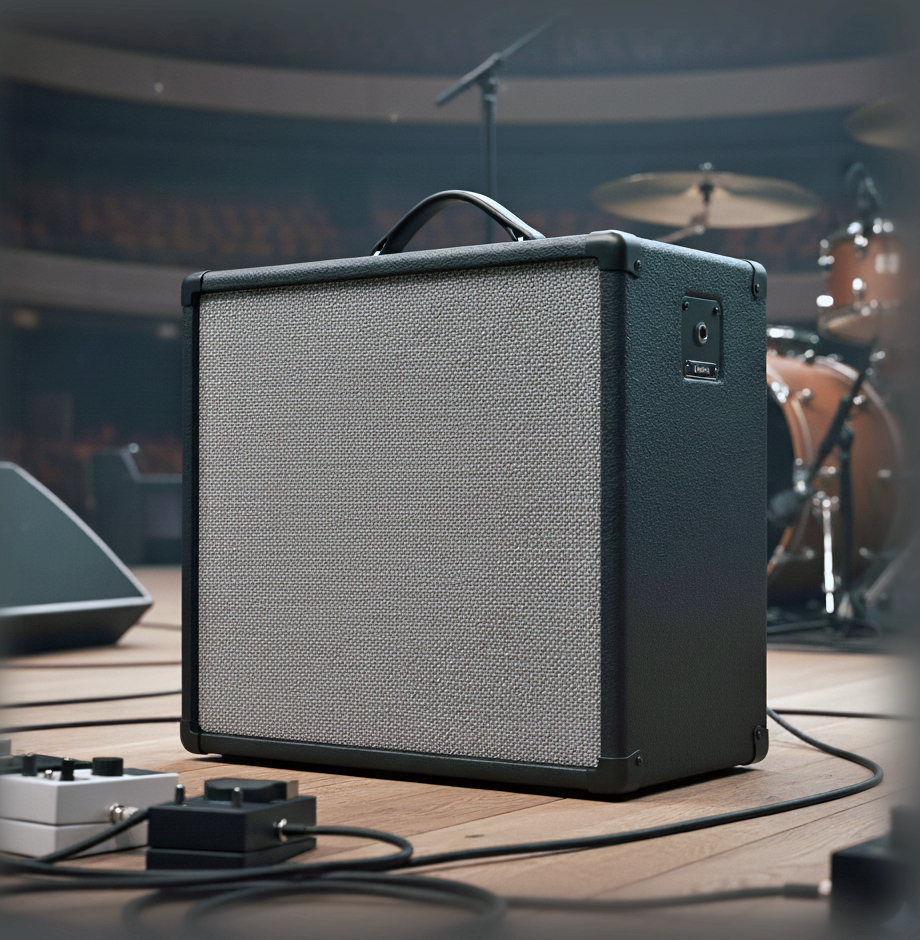
Building your own 1×12 guitar speaker cabinet is a rewarding project that allows plenty of scope for customisation and the great news is you don’t need to be an acoustic engineer to design a fantastic-sounding cabinet!

While measurements like the Thiele-Small parameters (Vas​, Qts​, Fs​, etc.) are crucial for high-fidelity audio or bass cabinets, guitar speaker cabinets are far more forgiving. They often sound best with a simple, well-constructed, and adequately sized enclosure that focuses on practical dimensions and volume.

Recommended 1×12 Cabinet Volume and Dimensions
The ideal size for a 1×12 cabinet strikes a balance between portability, sufficient internal volume for bass response, and manageable size. Too small, and the tone can sound boxy and thin; too large, and it can become overly boomy and lose focus.

A recommended internal volume for a versatile 1×12 guitar cabinet falls in the range of 42.5 to 70.8 litres (1.5 to 2.5 cubic ft). For a good starting point, consider these external dimensions for a typical square-shaped cabinet, which provides a good compromise:

Dimension Measurement Metric Equivalent
Height 18.0in 45.7 cm
Width 18.0in 45.7 cm
Depth 12.0in 30.5 cm

This results in an external volume of 18×18×12=3888 cubic in (≈2.25 cubic ft). After accounting for the thickness of the typical 18mm (¾ ​in) plywood the internal volume will be well within the recommended range.

Open-Back vs. Closed-Back Design
The choice between an open-back and a closed-back design is the single most significant acoustic variable you control, and it’s simply a matter of preference and intended use:

  • Closed-Back:
    a) The entire back panel is sealed.
    b) Sound: Tighter, more focused bass response, greater projection, and often preferred for higher-gain or heavier music. The sound tends to be directional.
    c) Construction: Slightly simpler, as it only requires one solid back panel.
  • Open-Back:
    a) A portion of the back panel is left open (typically 30%−60% of total area).
    b) Sound: Broader, more ambient sound dispersion, often perceived as more “airy” or “chimey,” with a looser, less focused low end. It’s common in vintage amps and often preferred by players of blues, country, and classic rock.
    c) Construction: Requires cutting or designing a two-piece back panel.

Pro-Tip: Many builders use a removable/modular back panel that can be configured as either open or closed, allowing you to easily experiment with both tones without building two separate cabs.

Electromechanical Speaker Measurements are Optional
As mentioned, there’s no need to dive into the technical specifications of your speaker—the Thiele-Small parameters (Vas​, Qts​, etc.)—to build a great guitar cab.

Why? Guitar speakers are designed to impart a significant portion of their character through breakup and distortion rather than ideal acoustic linearity. The non-linear behaviour of the cone and the cabinet’s internal reflections contribute to the final tone much more than precise low-frequency tuning. The small, practical size of most 1×12 cabs naturally creates a high resonant frequency, rolling off the bass frequencies that the complex T-S calculations are usually trying to optimise. For a guitar cab, practical size and solid construction are far more important than exact mathematical tuning.

The Universal Platform: Why This Design Suits Most 1×12 Speakers
The primary function of a guitar speaker cabinet is not acoustic perfection (as with Hi-Fi gear), but rather tonal coloration and character. These recommended dimensions function as a versatile, “classic-sized” platform that accommodates nearly every major type of 12-inch guitar speaker.

Here is why this generic design works regardless of your speaker choice:

The Midrange Focus
Electric guitar occupies a concentrated frequency range, primarily (although not exclusively) from around 82 Hz (low E) up to 5 kHz or thereabouts. The vast majority of a speaker’s “tone” is created by its response within the midrange and high-mid frequencies (500 Hz to 4 kHz).

The moderate internal volume of 1.5 to 2.5 cubic ft is designed to manage the lower frequencies. It is small enough to prevent excessive, uncontrolled bass (which can sound muddy) but large enough to let the fundamental frequency of the guitar breathe. This means whether you install a ceramic magnet speaker (e.g., Celestion Vintage 30 or Greenback), known for being punchy and aggressive; alnico magnet speaker (e.g., Celestion Blue), known for compression and chime; or neodymium speaker (e.g. Neo Creamback), known for a faster pick response.

In each case, the cabinet provides a neutral, robust environment that lets the unique sonic character of that specific speaker shine through, without the box itself colouring the sound in a negative way.

Physical Standard
All standard 12-inch guitar speakers share the same mounting hole pattern and baffle cutout diameter. By adhering to the recommended dimensions, you guarantee that the baffle board has enough surface area and structural integrity to securely hold any 12-inch driver (including large-magnet versions) and that the speaker’s magnet will clear the back panel of a closed-back design. This makes the cabinet a true “hot-swappable” enclosure , allowing you to change speakers easily to fine-tune your sound without rebuilding the box.

Acoustic Damping (Open vs. Closed)
As previously mentioned, the choice between open-back and closed-back is far more influential on the final tone than small variations in volume. Once you choose your preferred back design (or build a convertible back), the general cabinet size is forgiving enough that slight differences in the speaker’s Qts (a factor in Thiele-Small parameters) will be completely overridden by the non-linear, musical properties of the guitar speaker itself, especially when driven hard.

In short, the goal of this DIY design is to create a structurally rigid, acoustically balanced box that is a reliable host for the speaker, ensuring that the speaker is the voice, and the cabinet is merely the supporting frame.

ADDITIONAL: Recommended 1×10 Cabinet Size
If you decide to go with a 1×10 speaker instead, which generally has less bass response and a snappier feel, you can significantly reduce the cabinet size.

The recommended internal volume for a 1×10 should be roughly 22.5 to 42.5 litres (0.8 to 1.5 cubic ft). Here are recommended external dimensions for a typical 1×10 cabinet:

Dimension Measurement Metric Equivalent
Height 15.0in 38.1cm
Width 15.0inch 38.1cm
Depth 10.0in 25.4cm

This provides an external volume of 15×15×10=2250 cubic in (1.3 cubic ft), making for a compact and focused cabinet ideal for practice or small gigs.

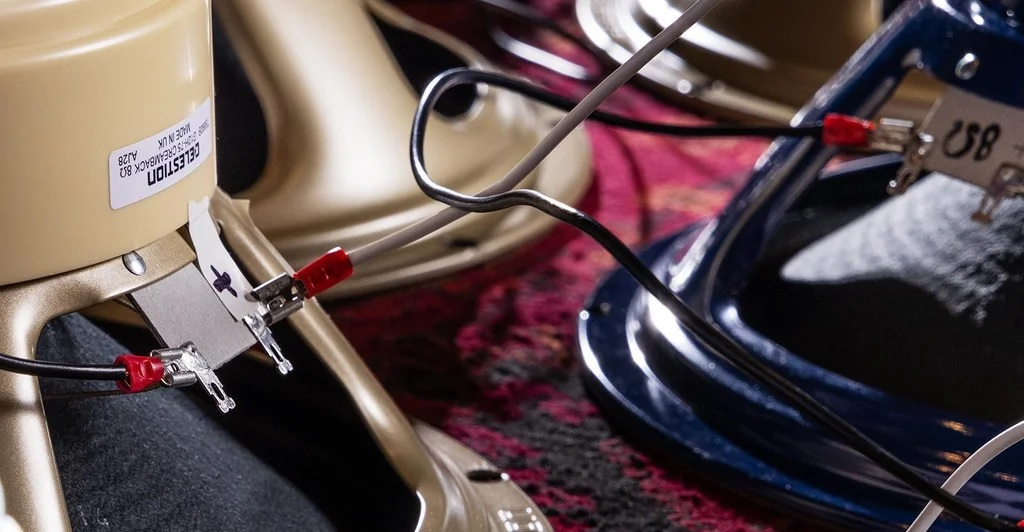
Wiring Your Own Guitar Speaker Cab: Keep It Simple!

So you’ve built a beautiful cabinet and picked out some sweet speakers—now comes the wiring! Don’t overthink this part; it’s one of the easiest steps, but getting it right is crucial for killer tone and reliability.

The Best Wire Type: Stranded Copper

Forget solid core, shielded cable, or anything fancy. For internal wiring within your speaker cabinet, the undisputed champion is stranded copper wire.

      • Why stranded? Unlike solid wire, stranded wire is flexible, which is important for moving speakers around and absorbing vibrations within the cab. It’s also less likely to break over time.
      • Keep it pure! Use oxygen-free copper (OFC) if you can. While the tonal benefits are debated, OFC is simply a higher-quality wire that’s less prone to corrosion, offering better long-term reliability

The Right Gauge: 16 AWG is King

The gauge (or thickness) of the wire matters. Gauge is usually measured using the American Wire Gauge (AWG) system, where a lower number means a thicker wire.

  • Go with 16 AWG: For the relatively short runs inside a typical guitar cabinet (usually a couple of metres or a few feet at most), 16-gauge speaker wire is the perfect choice. It’s thick enough to handle the current and low impedance (usually 4, 8, or 16 ohms) without any power loss, but it’s still flexible and easy to work with.
  • The alternative: You could use 14 AWG, but it’s often overkill and harder to manage. Avoid anything thinner than 18 AWG, as it may not handle high-wattage amps well and could introduce unnecessary resistance.

In short: Grab some 16 AWG stranded OFC speaker wire, keep the lengths as short and direct as possible, and secure your connections with solid soldering or high-quality crimp connectors. You’ll be rocking that DIY tone in no time!

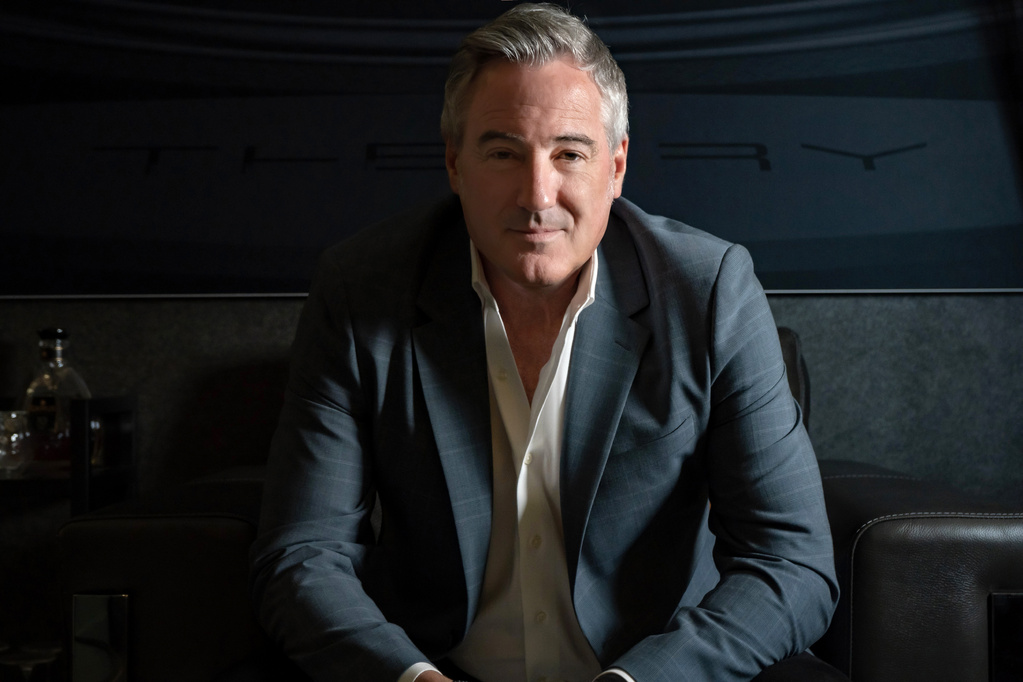
Celestion Presents an Interview with Paul Hales, Owner and CEO of Theory Professional

Celestion Presents an Interview with Paul Hales, Owner and CEO of Theory Professional

From its conception in 2018, Theory knew that if they were going to bring real value to the residential, commercial, and professional installation market, that they needed to be different.  With that as their inspiration, they quickly became renowned for providing unique, high-performance products with innovative form factors and a strong focus on sound quality that sets them apart from competitors. Celestion is pleased to present an exclusive interview with Paul Hales, the Owner and CEO of Theory Professional, where he shares his formative years, the origins of the company, their philosophies, culture, innovations, the future of their business, and his favourite music.

What is your favourite album of all time and why?

I find it difficult to name just one, but if pressured, I would narrow it down to Radiohead’s OK Computer and In Rainbows, and Counting Crows’ August and Everything After. With Radiohead, I appreciate Thom York’s melodic singing, and the complex textures and layering they achieve in their compositions, which combine progressive rock elements with beautiful melodies.  A number of their songs, Exit Music for a Film, The Tourist, and Lucky are just beautiful rock compositions.

How did you get started in the audio industry?

My interest stemmed from a combination of a love for music and my father’s background in hi-fi, as he built things like Heathkits and speakers using JBL drivers. I was exposed to music from a young age through my sisters, who were 10 years older than me. They turned me on to the Beatles and early 70s popular music.  When I was five or six, I remember receiving my very first record, a 45 of Hey Jude. Then I just embraced music, especially in late middle school and high school, I listened to hundreds and hundreds of hours of music every month in high school.

In grade school, I played drums and cymbals in the band, and then in middle school, my parents bought me a Ludwig drum set, and I had a band with friends playing popular music of the time, like Kiss.

Then, the little stereo I had broke. It was an all-in-one AM/FM receiver with an 8-track on the front and a record player on top. My dad would normally just fix it, but in this case, he couldn’t. I had been driving my parents crazy with the drumming and he said “Why don’t you sell that stupid drum set and buy a real stereo,” and so I did that. I got a good amount of money for the drum kit and spent $670 on a Hi-Fi system.  It was 1977, so that was a pretty decent rig, especially for a 12-year-old, and then I was hooked!

My interest in audio equipment grew from there. I designed and built my first speakers at 16, purposefully taking a woodwork class in high school to construct the cabinets. I even built my own crossovers.  I really loved the whole process, the concepts of engineering, industrial design, being able to style these things. That inspired me to go to college with the intent of starting a speaker business, and I tailored my coursework at UC Davis to loudspeaker applications.

How did you get started in the business itself? Take us on your path to Theory Professional.

I started my first commercial speaker company, Hales Design Group, in 1988, focusing on high-end audiophile products. During the 1990s, I gained notoriety in the audiophile segment and devoted thousands of hours to correlating measured data with perceived sound quality.

Towards the late 90s, I got disillusioned with audiophile products and all the industry dogma, in general. Hi-Fi sound is small and polite. Many of the technologies used in Hi-Fi products, including the widely used dome tweeters are very inefficient and can’t convey the real power and dynamics of live music.

This feeling of disillusionment led me to join QSC in 2000 as their first employee on the loudspeaker side, establishing their R&D department for speakers. I spent four years designing professional speakers for various applications, learning how to create speakers with exceptional dynamic range that also sounded like hi-fi speakers. This has been my unique value proposition for the last 25 years.

This approach now underpins two businesses: Pro Audio Technology, which caters to high-end private screening rooms with commercial cinema-style speakers that offer hi-fi accuracy, and Theory Audio Design (Theory Professional), which extends this approach to broader residential, commercial, and professional applications. I am the owner and CEO of both companies.

Theory Professional is renowned in the industry. In your viewpoint, what’s the main reason for that?

Our primary strength is our ability to achieve exceptional levels of accuracy in speakers, including large-format sound reinforcement systems. Theory Professional offers a unique approach in the small-to-medium commercial installed sound and sound reinforcement segments. While other brands often replicate existing designs, our products are entirely different; they are made from aluminium, feature high-end proprietary transducers, which Celestion supplies, and boast unique, compact, and shallow form factors. This innovative product, combined with hi-fi sound quality and high output, alongside a focus on superior design, has been very well-received by the market.

What do you believe your most innovative product or service is?

Our general philosophy is to keep our product catalogue simple, which in our competitors, we find to be overly complicated with hundreds of similar products. We aim for a more streamlined and premium approach, similar to Porsche’s car philosophy of offering fewer, highly effective models. A specific example of this is our ic6 Acoustic Core, a six-inch ceiling speaker that can also function as a pendant loudspeaker or a landscape loudspeaker when mounted in appropriate enclosures. This standardisation simplifies inventory and maintenance for our customers, allowing a single part to serve multiple audio needs.

Outside of your company, what do you think has been the single most important technological achievement in our industry?

That’s a tough one, and normally, I spend more time talking about the absence of technological advancements in our industry, particularly in loudspeakers. I have a supercomputer in my pocket and we have artificial intelligence now, but some speaker brands are still making the same models that they introduced in the 1970s. So, on the loudspeaker side, there hasn’t been that much innovation.

Expanding to our industry in general, I believe the most significant achievement has been the advent and refinement of Class D audio amplification. Class D amplifiers have benefitted the industry by becoming much more efficient, lighter, and smaller, significantly reducing the size and weight of equipment racks while increasing power output. Crucially, their performance is now on par with linear amplifiers.

What is the accomplishment you’re most proud of?

I am proud of helping QSC develop their corporate logo and industrial design language for loudspeakers, which became distinctive yet tasteful and are still in use today, 25 years later. We began with a goal of making QSC loudspeakers identifiable from across the room, and they still are.

However, I am probably most proud of the conception and positive reception of Theory Professional as a brand. We set out to disrupt the status quo, and despite being a small team, we are executing at a very high level, leading to early success with high-end projects and rapid industry adoption.

Can you talk about the culture of your organisation and how you like to lead?

Theory Professional operates with a small group of highly effective and dedicated individuals. Our culture revolves around high performance; we are a team of smart, hardworking people striving to achieve significant goals. We value individuals who are naturally driven to work hard, accomplish great things, and gain satisfaction from their achievements.

To put it more obnoxiously, I have a sign outside of my office that reads “No stupid people beyond this point,” but “We only like to hire smart people,” might be a more polite way to say it.

How are you poised for the future?

We believe our future lies primarily in the commercial install side of the business, where we have already achieved early success with significant projects. Theory is establishing itself as a recognised brand in the residential market and is quickly gaining traction commercially since introducing Theory Professional in 2023. As a smaller business, our resilience and ability to quickly adapt to industry changes and customer demands gives us an advantage over larger companies that might find it harder to pivot rapidly. Our strong customer relationships and reliance on referrals also position us for continued growth, as new client relationships often begin with recommendations.

We started talking about your favourite album of all time, but what are you enjoying listening to these days?

I listen to two main types of music. For relaxation, I often stream a playlist of slow classical music based on Erik Satie, it’s mostly music from the late 1800s Impressionist era, such as Claude Debussy. When not relaxing, I listen to a wide range of genres, from classical to metal. When I am not trying to relax, our team at Theory Professional has a playlist called “Ones We Really Like”, featuring songs across various decades and genres, including 1950s acoustic jazz, early rock and roll, Led Zeppelin, Cream, The Moody Blues, and 90s popular music.

But my favourite band is Tool and if they come out with a new album then I’ll listen to that non-stop for a couple of months straight. I was on an airplane flying to China for the first production run of Theory products and their Fear Inoculum record had just been released. I put on my earbuds, pressed play and thought, “what is happening inside my head right now?” I was obsessed with that record because of the complexity, the intelligence, and the polyrhythms between the bandmates. So, until a new Tool album comes out, I’ll probably stay with the playlist.


Trivium, Celestion and the Lifelong Quest for Tone

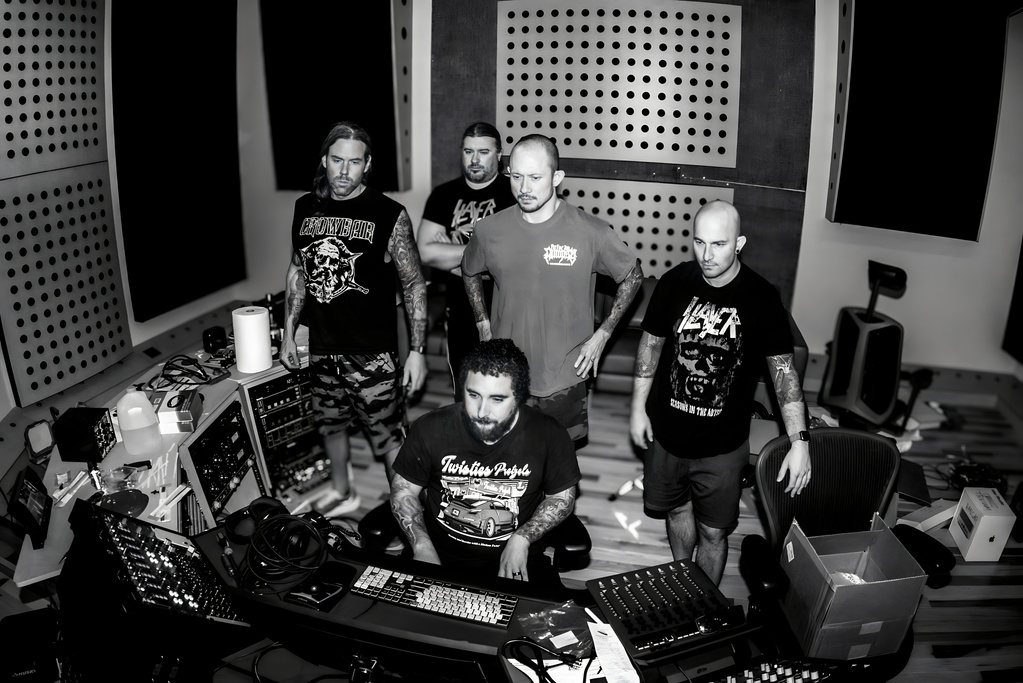
For twenty-five years, American heavy metal band Trivium has consistently pushed the boundaries of their sound, crafting a sonic tapestry that seamlessly blends intricate arrangements with crushing heaviness. Throughout their career, a constant in their sonic arsenal has been Celestion speakers, most notably Vintage 30s (and Celestion built Marshall Vintages), Creambacks, Greenbacks, and various other models. We sat down with vocalist and guitarist, Matt Heafy and guitarist, Corey Beaulieu at their newly completed studio, THE HANGAR, to talk about their musical journey, the importance of tone, and their enduring partnership with Celestion.

How did your musical journeys begin? What were some of your early influences?

Corey Beaulieu: My musical journey started with my parents and siblings always having music on in the house. The first band that really got me excited about music was Guns N’ Roses, it was the Use Your Illusion II album. When I was eight, I got my first guitar, and the more I played, the more I became drawn to playing music. Discovering more cool metal bands added fuel to the fire and here we are today.

Matt Heafy: When I was around 11, I unsuccessfully tried out for a pop-punk band. After that experience, I gave up on music, but then a friend lent me The Black Album by Metallica. One listen, and I knew that was the kind of music I needed to make. I locked myself in my room for hours learning every riff and trying to emulate those sounds. Then for my eighth-grade talent show, I covered No Leaf Clover by Metallica and afterward, I was asked to audition to be the lead guitarist of a two-week-old high-school band called Trivium. This group of 16- and 17-year-olds were skeptical when they saw a middle-schooler walk in, but I launched into For Whom the Bell Tolls, played it perfectly, and I’ve been in the band ever since.


Those were your musical influences, how about your tonal influences as a guitar player?

Matt Heafy: Obviously, The Black Album was huge for me, and in my opinion, has some of the greatest metal tones of all time. Sonically, that album made me realise you don’t need excessive gain to achieve heaviness.
Metallica led me to Pantera and Megadeth, but what really got me deep into tone was a series of records produced by Andy Sneap. I was obsessed with Jeff Loomis’s guitar sound on Nevermore’s Dead Heart in a Dead World album. I loved the lead and melody guitar sounds of Arch Enemy’s Wages of Sin and I really liked his work with Testament. Those influences ultimately led us to work with Andy on our album Ascendancy.

Let’s talk about your history with Celestion. When did you first discover these speakers and what role do they play in shaping your signature sound?

Matt Heafy: We’ve used Celestion from the very beginning. When we first started playing live, I was living the dream, playing through big Marshall cabinets on stage, I think 1960Bs. One day I looked in the back and saw the name Celestion. That was how I first came to respect the brand.

Not long after, Jason Suecof introduced us to the Celestion BVs (the Celestion-built Marshall Vintage speaker loaded into the Marshall 1960BV cab) during pre-production for our Ember to Inferno album. He explained that they break up more and have more natural distortion and compression. We were obsessed once we played through them. And when we worked with Andy Sneap on Ascendancy, he used Mesa Boogie oversized Rectifier cabs with the same speakers.

To this day, the Trivium tone generally consists of a Peavey 5150 series head and a cab loaded with Celestion BVs or Vintage 30s. Any cab we’ve ever received that didn’t already have Celestions, had Celestion put in soon after.

Corey Beaulieu: I didn’t know much about speakers when I first joined the band. In 2005, we were playing a show at a venue in Buffalo, New York. All the acts on the bill were planning to rock their own 4×12 cabs, but the stage was too small. To save space, the headliner decided we’d all share their backline cabs and just swap out our amp heads. They were using Mesa Boogie cabinets with Celestion Vintage 30s. Even though we both used the same Peavey amp model, I was blown away by the difference in tone. They sounded so much heavier and cooler than what we were using!

That night in Buffalo was an eye-opener. Once I played through a 5150 amp, paired with a Mesa cabinet loaded with Celestion Vintage 30s, I knew why I started seeing so many people playing them on tour. It became the go-to combo for metal at the time.

Can you tell us about your current live rig and how it differs from your studio setup?

Corey Beaulieu: Live, we use EVH Stealth heads and cabs loaded with the special Eddie Van Halen Celestion speakers. We don’t have a set studio rig. Peavey EVH amps are generally the foundation of everything we do, but we’re in our new studio now mixing and matching different heads, cabs, and Celestion speakers to explore the sounds we can get.

Today we have Vintage 30s in an EVH cab, BVs in a Mesa Cab, and Vintage 30s in a Marshall cab. You’ll get different sounds from cab to cab, even if they have the same Celestion speaker, so it’s all about finding which combination works the best for what we’re doing in any particular session.

Matt Heafy: We’re also playing with a ton of amps at THE HANGAR, including older Peaveys, a JSX, a Triple X, a 6534 Plus, Block Letters, a 5150 II, a 5150 III, and a Soldano. We’ve found that the older 5150s need something before the head, and are using a Maxon Red overdrive into an ISP Technologies Decimator to help us get the most out of them. I’m playing my Gibson Les Paul Standard with custom Fishman pickups.

Corey brought most of the amps and cabinets into the studio. We’re finding some of the best combos we’ve ever played through. I’m having so much fun, it’s taking me back to feeling like a kid.


What you’re doing in your new studio represents a significant step forward for Trivium.
Tell us more about THE HANGAR.

Corey Beaulieu: When we first started recording there were studios everywhere, but many large studios are closed now. Those that are left often require you to work with a specific producer. We wanted a space where we could be free to create on our terms and we wanted it in Orlando, so we wouldn’t need to travel to record.

We were inspired by Metallica’s HQ and the way they use their space to jam, rehearse, and record. We already had an old hangar that we’d set up to rehearse for tours, so the next logical step was to build a studio in it.

Our buddy, producer, and engineer, Mark Lewis introduced us to the renowned studio designer, Roger D’Arcy. Roger was convinced that taking a room in the hangar and trying to make it a studio, wouldn’t be optimal. He suggested that if we built something from the ground up, we could have the best studio room we’ve ever been in and everything would be perfect.

We agreed and Roger and Mark got to work. We took our time to make sure everything was right and didn’t cut any corners and THE HANGAR has finally come together in the last couple of weeks. Between all our guitar equipment and the new recording gear, it’s the most outfitted studio situation we’ve ever recorded in. Now we have our studio and it’s exactly the way we want it, the ways that will work best for us.

The room came out amazing. I’m excited to finally have sounds emanating from this project we’ve worked on for so long. It’s definitely in the early phase and we haven’t scratched the surface of how everything will sound with this new studio setup.

How are Celestion speakers factoring into this new creative space?

Matt Heafy: We mentioned that we’re matching speakers, cabinets and heads and we have a huge Celestion library to do it with. We’ve got Vintage 30s, G12M-65 and G12H-75 Creambacks, G12M Greenbacks, G12H Anniversaries, plus all the older models we’ve accumulated over the years. Mark has been doing surgery, swapping speakers in and out of cabs. He even put four different Celestions in a single cabinet for testing in our isolation booth.

Corey Beaulieu:  We use a variety of different makes of cabinets with our Celestions: Mesa Boogie, Marshall, and EVH. That’s because the differences in the types or thickness of wood, the way they’re constructed, the air volume in the cabinet, can bring out different characteristics from the speaker.  The same Vintage 30 in a Marshall sounds different in a Mesa cab.

Matt Heafy: Right now, our mission in THE HANGAR, is to get ideas of what we dig and those will be the launchpad where we’ll start when we begin tracking. We’ll have given all our speakers and cabinets the run-through, and we’ll know which combo will bring that extra magic to the tone that’s needed.

Any little variable in tone can be inspiring and that’s the big thing. I don’t want people to think that we’re just collecting gear to collect gear. It’s not that at all. Every little thing can drastically change how you’re performing, feeling, and playing when you’re making music and that’s all anyone is looking for. That’s what this quest of tone is. This obsession with gear has always been to find something new to inspire you to come up with new ideas, and you never know where it can lead you.

You have complex arrangements in your music, how do you balance heaviness versus clarity in your tone?

Matt Heafy: Younger guitar players tend to think that more gain equals a heftier guitar tone, but it’s really a misconception. You won’t hear what you want by having all the dials set at 10 and getting blasted with distortion. Ironically, I used to do that as a kid, but I’ve learned that less gain actually equals a tighter tone. If you look at the Peaveys we’re playing right now, our pre-gain is set around six and our post-gain is around one or two. It’s about finding the right balance of gain and volume where you still hear your hands come through.

Corey Beaulieu: When people first get into recording, it’s common to crank the gain or the low end to get that full sound. But the reality is on the records where the guitar tone is great, if you really listen there isn’t an oversaturated, crazy amount of gain. That’s because when you’re recording, you’re layering multiple rhythm tracks and everything builds up. Once you start stacking guitar parts on top of each other, if everything is high gain, you’ll end up with this mess of a guitar sound. But if you keep the gain levels moderate on your layered tracks, you get this powerful wall of guitar sound.

Any final thoughts you’d like to share with aspiring guitarists?

Corey Beaulieu: Where we’ve been talking about sounds and tone, it seems like the younger musicians of today grew up using plug-ins and amp modelers, whereas people Matt and my age, grew up playing through cabinets and heads. There’s some magic to plugging into a tube amp and speaker cabinet when that feeling, that electrifying push of air happens. It’s something you can’t recreate when you plug into your laptop.

Some guitarists need or have no choice but to play through plug-ins or samples, and they serve their purpose, but I find that there’s just this extra organic vibe, sponginess, and percussive response when playing with real heads and cabs in person. I wish more younger people could experience how cool that vibe is.

Matt Heafy: Corey and I have been sharing what we love and what makes us sound and perform our best. What we do may not work for or be accessible to everyone. So, it’s important for musicians to notice when they pick up or plug into something if it makes them feel good.

Even though it may not be what others say is correct, if you play a plastic guitar and it makes you write your best riffs, that’s the right instrument for you. If playing through a tiny Roland Micro Cube makes you feel good, that’s the right amp for you. Likewise, if you play a $10,000 handmade custom guitar and it inspires you, that’s right for you.

We’ve discovered what’s right for us from years of experimentation, research, and playing. Every musician has to find what’s right for them on their own because there’s no right or wrong answer when it comes to music. If you love it, that’s what matters and I think that’s the amazing thing about music.

##

Celestion to Showcase Impressive Range of PA Products and Solutions at Prolight + Sound Guangzhou

Guangzhou, China (May 19, 2025) —Celestion, one of the world’s leading suppliers of professional loudspeakers and compression drivers for sound reinforcement applications, will showcase key products from their pro audio range at the upcoming Prolight + Sound Guangzhou show, in particular demonstrating their flagship high-performance subwoofer, the 24-inch diameter TSQ2460.  Also on display are two now-in-production models from the UK-built, neodymium magnet Ten Squared (TSQ) range, the TSQ1845 and TSQ2145. Elsewhere on view is the versatile, high- performing ferrite magnet  PowerProX18 subwoofer, the latest 1.4-inch exit compression drivers, including the soon-to-be released CDX14-3035, and the upcoming neodymium magnet CNX0820 common motor coaxial driver, featuring an integral constant directivity horn.

TSQ2460

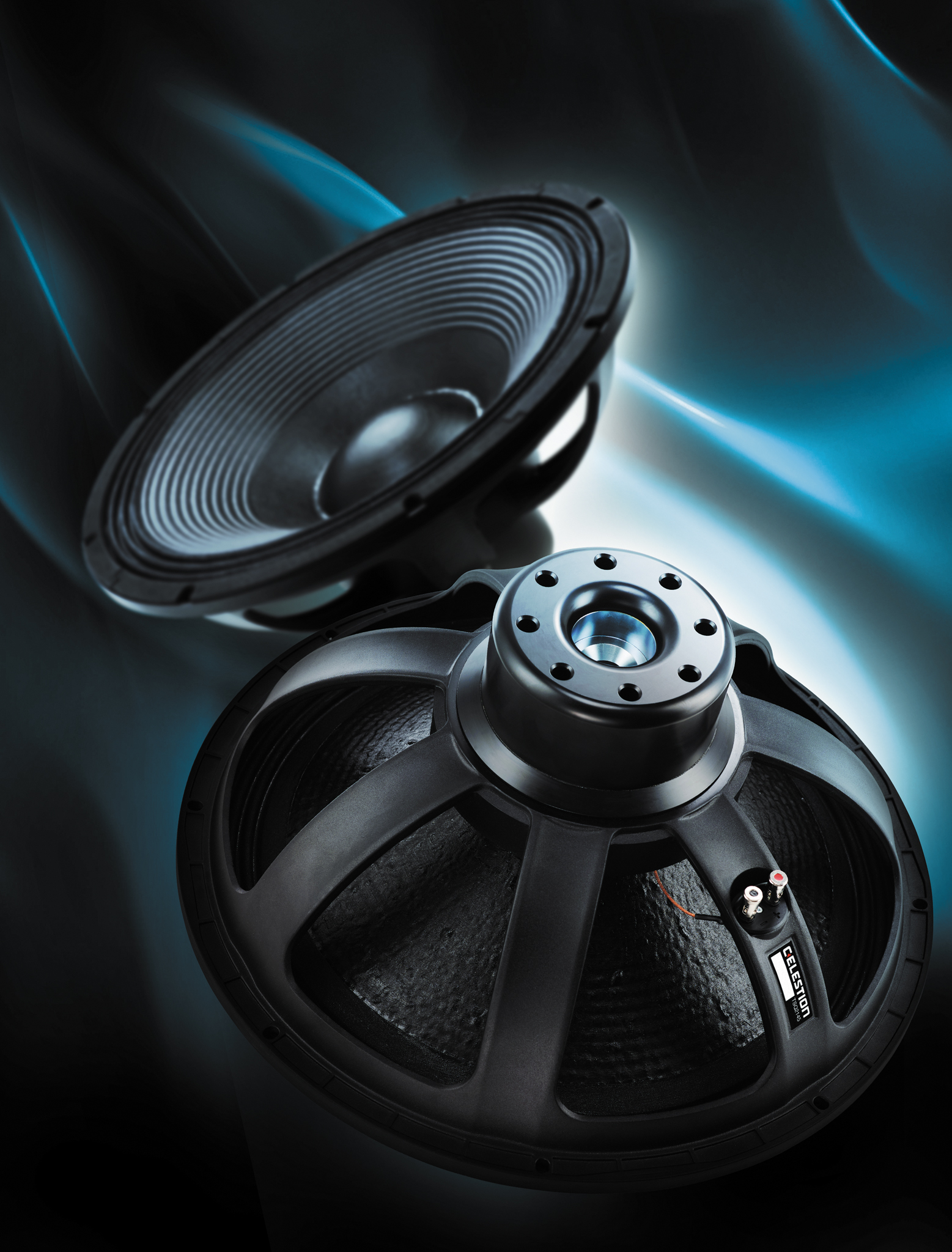
The Flagship 24-inch TSQ2460 aluminium chassis, neodymium magnet, low frequency loudspeakers are meticulously engineered for use in high powered subwoofer applications including: paraflex and folded horns and bass reflex designs.

The groundbreaking TSQ range has been born out of a specialist development program at Celestion’s UK-based R&D facility, embodying Ten Squared Technology, offering a number of incremental design improvements that together add up to a new standard in LF driver performance and durability. TSQ transducers are assembled on a new state-of-the-art robotic production line at Celestion’s UK-based research and manufacturing facility and represent a culmination of the company’s 100 years’ experience in loudspeaker engineering and the integration of Celestion’s latest feature innovations. TSQ drivers are designed without compromise to deliver consistently superior levels of performance in the most demanding professional sound reinforcement applications, even after hundreds of hours of use.

The TSQ2460 has a remarkable power rating of 2500W (nominal, AES standard)/5000W (continuous) thanks to the enhanced cooling offered by the highly efficient Precision Tuned Venting (PTV) system together with a proprietary voice coil featuring advanced heat-resistant adhesives. The cooling benefit is as much as -80°C, versus conventional designs.

The specially reconfigured magnet assembly allows much greater cone excursion and a remarkably high Xprotection level. The driver’s motor strength and mechanical compliance reach their defined Xprotection limit at practically the same point, achieving a low distortion performance, even during high excursion. This capability is complemented by Ten Squared’s unique, polysiloxane-laminated dual suspension that enables the driver’s suspension system to work much harder without losing stiffness, providing better coil control and a reduced likelihood of DC shift, while simultaneously increasing speaker longevity.

Also on display from the Ten Squared range are the 21-inch TSQ2145 and 18-inch TSQ1845, both meticulously engineered for subwoofer applications.

PowerProX18

The 18-inch, ferrite magnet PowerProX18 subwoofer delivers a relentless high-quality performance that makes it ideally suited to applications including cinema sound, fixed install and touring sound reinforcement.

The subwoofer features an advanced cooling design, developed for ferrite magnet assemblies, that enables its voice coil to run significantly cooler than comparable competitor drivers. This greatly reduces heat-related stress on the 4-inch glass-fibre voice coil former and other thermally sensitive parts. It also reduces the temperature-related rise in Re (coil resistance) that causes power compression. By operating at less severe temperatures, the subwoofer offers end users brand-new-out-of-the-box high performance throughout the product’s lifespan.

With a nominal impedance of 8 ohms, the PowerProX18 subwoofer’s power rating is a mighty 1200W (nominal, AES standard)/2400W (continuous). Sensitivity, measured at 1W@1m in 2π space is 97dB. The Bl (motor force) curve of the PowerProX18 exhibits remarkable symmetry, and thanks to the cone’s polysiloxane-laminated dual suspension, which provides greater stability and improves cone displacement symmetry, the K (stiffness) curve again reveals superb symmetry resulting in notably reduced distortion.

PowerProX18 is designed for longevity of high performance, delivering maximum durability and reliability throughout the lifespan of each speaker. It is intended to surpass the performance of other 18-inch subwoofer drivers in its class, making it ideal for challenging sound reinforcement and cinema sound applications.

 CDX14-3035

Celestion’s new 1-4-inch, ferrite magnet CDX14-3035 HF compression driver is an upgraded version of the earlier CDX14-3030 model. Featuring a single piece titanium diaphragm, it is identical in performance to the CDX14-3045. However, it has been built with a ferrite magnet for applications where size and weight are less important than cost considerations.

This high-quality HF solution features a power handling capability increased to 120W (nominal, measured to AES standard)/240W (continuous) and an enhanced sensitivity of 108dB plus lower crossover point of 800Hz (12dB/oct).

In addition, the CDX14-3035 features a 75mm/3-inch diameter edgewound copper clad aluminium voice coil, and 35mm/1.4-inch exit size. The unit features an enhanced surround shape for greater linearity with a high temperature polymer clamp ring that contributes to lower distortion.

The companion models, Celestion’s new neodymium magnet HF solutions, the 1.4-inch exit CDX14-3045 and CDX14-3055 will also be on display.

 CNX0820

Shown at final prototype stage, the CNX0820 is the first of a new family of coaxial drivers from Celestion and is scheduled for launch later in 2025.

The unit features a 2-inch edgewound copper clad aluminium voice coil (LF) and a 1.75-inch edgewound, copper clad aluminium voice coil (HF), with the neodymium magnet assembly acting as a common motor for both low and high frequency elements. The device’s integrated constant directivity horn provides 50° dispersion. In addition, the unit features twin demodulation rings to reduce harmonic distortion and a field repairable polyimide HF diaphragm.

The CNX0820 offers a power handling of 250W (nominal, AES Standard)/500W (continuous) and 95dB sensitivity. It is ideal for compact and discreet sound reinforcement applications such as architectural installations where a two-way system may need to be deployed in a small area.

Visit Celestion at Prolight + Sound Guangzhou, Booth F16, Hall 4.2 China Import and Export Fair Complex, No. 380, Yuejiang Zhong Road, Guangzhou.

About Celestion

With worldwide headquarters in Suffolk, England; Celestion design, develop and manufacture high-quality professional audio loudspeakers and compression drivers for sound reinforcement, as well as premium guitar and bass guitar loudspeakers. These world-renowned speakers are used onstage and in clubs, theatres and other venues the world over. With more than 100 years of success, the company continues to offer the latest technologies and innovations in the world of loudspeakers. celestion.com