Celestion Presents an Interview with Geoff McKinnon, Director of Engineering & Quality at EAW

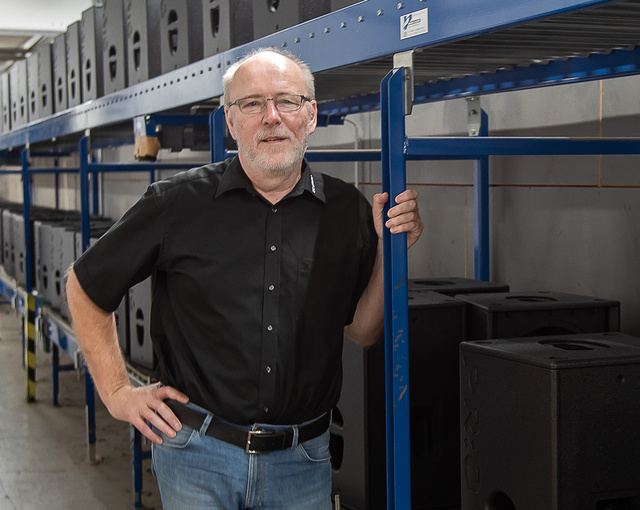
Whitinsville, MA (January 12, 2022) — Eastern Acoustic Works (EAW) has been designing and manufacturing advanced loudspeaker systems since its founding in 1978. The company prides itself at listening very carefully to their customers’ needs and responding with innovative products and solutions to help them in achieve consistently stellar performances. These days, every EAW loudspeaker system is controlled by their proprietary advanced software application, Resolution, which empowers clients to be able to map, audition, monitor and dynamically refine their sound systems to match the requirements of a specific application or venue. As part of the Legends interview series, Celestion sat down with Geoff McKinnon, EAW’s Director of Brand Engineering and Quality, to discuss the pro audio industry, his technical innovations and career at the company, and music in general.

The combination of music and technology has always captured McKinnon’s interest, who from a young age, was always curious about how things worked.

“When I started playing in bands in high school, I quickly found myself running sound for bands as well as for school and church events. That’s where I discovered the Pro Audio world – mixers, loudspeakers, microphones and how the systems were set up, McKinnon says. “And I always really wanted to be an engineer. I studied electrical engineering at Rensselaer Polytech Institute (RPI) in Upstate New York. I was really fortunate that RPI had a sound club, and the school owned all this great gear including mixers, loudspeakers, microphones, etc. I really got to share and learn with other students.”

It was through a friend in that same sound club that McKinnon first discovered EAW:

“A friend and alumnus of that sound club worked at EAW and gave me a tour. At that point, I was hooked — I knew that I wanted to design loudspeakers,” he adds. “It took a few years but I finally got an opportunity to work at EAW as an acoustic engineer. It gave me a chance to work with and learn from a number of talented industry veterans and be a sponge and absorb it all! After working on a wide variety of projects, I was asked to work on an advanced loudspeaker system, which would become EAW’s flagship line, the celebrated ADAPTive series of products, including the Anna and Anya adaptive arrays, the Otto adaptive subwoofer, and now the new AC6 adaptive column loudspeaker.”

In terms of EAW’s position as an industry legend, McKinnon points out that the company has always been about innovation that works for the customer.

“In our case our most innovative product is not necessarily a loudspeaker. I feel it is EAW’s Resolution 2 software, which allows for system design, venue modeling and operation of all EAW’s loudspeaker products within one application. Resolution software is really what empowers our entire product family. The high performance of our ADAPTive loudspeaker systems would not be possible without this powerful software. Resolution calculates the parameter set to adapt the coverage of the loudspeaker system to any venue and make changes in real time. That power is in the software.  Resolution 2 is free to download from our website so it’s also the easiest EAW product to experience.”

When asked about the most important technical achievement in the PA industry, McKinnon points to two innovations – Digital Signal Processing and accurate computer modeling tools.  As he says, “These both have really changed the ability to predict the performance of a sound system in a very precise way. We can now be confident that we can have consistent performance day to day, venue to venue.  This was not possible before these advancements.”

And in terms of EAW’s innovations and success, McKinnon gives credit to the team at EAW:

“Our team is quite dedicated.  We have a work smarter not harder approach to solving problems and helping our customers. For me, I really try to empower each person on the team to deliver products and solutions which help demonstrate their own individual passion for what they do. I want to ensure that talented people have the power to express that passion in products they develop, and solutions that are delivered to customers, adds McKinnon. “And we are always committed to continually innovating and developing exciting products to serve the needs of our customers.”

Click here to read the full interview with Geoff McKinnon on the Celestion Speakerworld blog.

About Celestion

With worldwide headquarters in Ipswich, England, Celestion design, develop and manufacture premium guitar and bass loudspeakers, and high-quality professional audio drivers for sound reinforcement. These world-renowned speakers are used onstage and in clubs, theatres and other venues the world over. Contact Celestion at: info@celestion.com and visit us on Facebook at www.facebook.com/celestion.

www.celestion.com


###


Celestion Presents an Interview with Geoff McKinnon, Director of Engineering & Quality, EAW

Eastern Acoustic Works (EAW) has been designing and manufacturing advanced loudspeaker systems since its founding in 1978. The company prides itself at listening very carefully to their customers’ needs and responding with innovative products and solutions to help them in achieve consistently stellar performances. These days, every EAW loudspeaker system is controlled by their proprietary advanced software application, Resolution, which empowers clients to be able to map, audition, monitor and dynamically refine their sound systems to match the requirements of a specific application or venue.

We spoke with Geoff McKinnon, EAW’s Director of Engineering and Quality, the brains behind these loudspeakers with brains.

What is your favorite album of all time and why?

For the past 25 years, my favorite album has been Metallica, Master of Puppets. I really like all the songs on that album, the wide range of songs, the fast pace and energy and all the guitar solos on that album.

What is the thing that made you want to be part of the audio/music industry? How did you get your start in the business? And with this company? What is your current position and how did you get there?

It has always been the combination of music and technology that captured my interest in Pro Audio. As a kid, I remember always being curious and trying to figure out how things worked, including guitars, pianos and musical instruments. That drew me to both music and technology.

When I started playing in bands in high school, I quickly found myself running sound for bands as well as for school and church events. That’s where I discovered the Pro Audio world – mixers, loudspeakers, microphones and how the systems were set up.

And from a young age, I always really wanted to be an engineer. I studied electrical engineering at Rensselaer Polytech Institute (RPI) in Upstate New York. I was really fortunate that RPI had a sound club, and the school owned all this great gear including mixers, loudspeakers, microphones, etc. I really got to share and learn with other students.

It is actually through a connection at that sound club that I discovered EAW.  A friend and alumnus of that sound club worked at EAW and gave me a tour. At that point, I was hooked — I knew that I wanted to design loudspeakers!

Of course, it took a few years, as industry positions don’t come up that often, but I finally got an opportunity to work at EAW as an acoustic engineer. It gave me a chance to work with and learn from a number of talented industry veterans and be a sponge and absorb it all! After working on a wide variety of projects, I was asked to work on an advanced loudspeaker system, which would become EAW’s flagship line, the celebrated ADAPTive series of products, including the Anna and Anya adaptive arrays, the Otto adaptive subwoofer, and now the new AC6 adaptive column loudspeaker.

I have been at EAW for 11 years and am now the Director of Engineering and Quality.

How did your background influence the job you do now? The company overall?

I’m fortunate that my background has been hands-on, working alongside audio professionals in the industry and their customers. That, along with my experience as a band member allowed me to understand Pro Audio as a service industry. The products we create need to perform well sonically and also be trusted by professionals from show to show. My experience has helped me understand the intangibles that matter in the equation beyond what is on the spec sheet.

You and your company are legendary in the industry. In your viewpoint, what is the main reason for that?

EAW is certainly an industry legend. EAW is a company that has always been about innovation — innovation that works for the customer. The best example of that is the company’s iconic KF850, the single box three-way loudspeaker. It was originally developed because customers had asked for a smaller 3-way loudspeaker with the same performance. This is also true of products in our popular MK line, which came from customer requests for major stadium needs.

Our same commitment to listen to our customer is true of the products that EAW develops today.

Which product do you consider your company’s most innovative?

In our case our most innovative product is not necessarily a Loudspeaker. I feel it is EAW’s Resolution 2 software, which allows for system design, venue modeling and operation of all EAW’s loudspeaker products within one application. Resolution software is really what empowers our entire product family. The high performance of our ADAPTive loudspeaker systems would not be possible without this powerful software. Resolution calculates the parameter set to adapt the coverage of the loudspeaker system to any venue and make changes in real time. That power is in the software.  Resolution 2 is free to download from our website so it’s also the easiest EAW product to experience.

What do you think has been/is the single most important technological achievement in our industry?

I believe that there are two important achievements, and it is hard for me to choose between them. Digital Signal Processing is one. The reasons are apparent with DSP enabling advancement to loudspeaker processing, amplification, and digital mixing consoles. It is now much easier to get a consistent and known result time after time, show after show.

The second achievement is accurate computer modeling tools. This is really applicable for loudspeaker systems in terms of being able to accurately model a sound system’s performance in a room – and with an accurate model you can then improve the results of through system deployment and DSP optimization.

These both have really changed the ability to predict the performance of a sound system in a very precise way. We can now be confident that we can have consistent performance day to day, venue to venue.  This was not possible before these advancements.

What is the accomplishment that you are most proud of?

Professionally, I am most proud of the acoustic design for EAW’s Anya and then later on, the Anna products. These systems rely on advanced signal processing but a system cannot sound great with processing alone. I would say that the inherent acoustic design enables these systems to sound great, the DSP is just icing on top. I am extremely proud of EAW’s development as a company, and my own professional development during both of these projects.  EAW was awarded six patents and two Parnelli awards, I’m really proud of those accomplishments.

Tell us a little about your company culture and your philosophy in leading the team.

EAW is actually a smaller organization than people may expect, and that is because our team is quite dedicated.  We have a work smarter not harder approach to solving problems and helping our customers. For me, I really try to empower each person on the team to deliver products and solutions which help demonstrate their own individual passion for what they do. I want to ensure that talented people have the power to express that passion in products they develop, and solutions that are delivered to customers.

How is your company poised for the future?

EAW has continuously strived to be in the best position to serve our customers. In response to changes with the pandemic, EAW has been enhancing manufacturing capabilities, service and support throughout the U.S. and Europe. This will help make it easier for our customers to get the products and parts they need during this time.

And we are always committed to continually innovating and developing exciting products to serve the needs of our customers.

Finally, what music do you enjoy listening to these days?

I am still listening to a lot of Metallica and more modern Rock and Metal. I have always enjoyed live music, which has been challenging during the pandemic. Certainly, as a loudspeaker designer, I love listening to any music that is well-recorded and purposeful.  I end up listening to a wide range of music like Folk, Jazz, Pop, EDM and everything in-between. Some stand outs for me are Diana Krall, James Taylor and Infected Mushroom.

I still try to go see Metallica every year. I went to their last concert in San Francisco just prior to the pandemic. And my wife and I are going to their upcoming 40th Anniversary Concert.

###

Reseller Warranty Policy

The warranty on Celestion loudspeaker products is valid for three (3) years from date of initial purchase, provided the product was originally purchased directly from Celestion or an authorised Celestion distributor.

This warranty covers damage specifically arising from defects in materials and manufacturing. Your speaker is not covered if damage has: been caused by product modification, accident, neglect, misuse, abuse;  been incurred during transportation; resulted from repairs, alterations, or misrepresentation by the vendor; been caused during initial shipping, for example a bent chassis*.

Note, the warranty will not cover any product that has had labels or date code defaced, modified or removed.

*All speakers are individually inspected at the factory before packing. Goods dropped from a height can become damaged, even with no sign of external box damage, therefore damage of this type must be claimed from the delivery company.

Reseller Warranty Claim Process

  • The reseller shall provide a report listing any warranty claim(s), using the standard form provided (Download here). The completed form and a copy of the associated dated invoice(s) should be sent to warranty@celestion.com.
  • Once Celestion has acknowledged the receipt of the warranty claim then product can be returned to Celestion if agreed necessary. Celestion will reimburse associated shipping costs if return is deemed a requirement. 
  • Celestion will evaluate each warranty report and where necessary, inspect the relevant products. A credit will be made to the reseller’s account for all valid warranty claims: the credit will be issued within one month of Celestion validating the warranty claim.
  • Inspection findings by Celestion’s quality department are final on all claims.

Celestion reserve the right to amend and modify this agreement at any time. E&OE

OEM Warranty Policy

The warranty on Celestion loudspeaker products for OEM customers remains in effect for three (3) years from date of manufacture, provided the product has been purchased directly from Celestion, an authorised agent or reseller.  

This warranty covers damage specifically arising from defects in materials and manufacturing. Your speaker is not covered if damage has: been caused by product modification, accident, neglect, misuse, abuse;  been incurred during transportation; resulted from repairs, alterations, or misrepresentation by the vendor; been caused during initial shipping, for example a bent chassis*.

In addition, the warranty will not cover any product that has had labels or date code defaced, modified or removed.

*All speakers are individually inspected at the factory before packing. Goods dropped from a height can become damaged, even with no sign of external box damage, therefore damage of this type must be claimed from the delivery company.

OEM Warranty Claim Process

  • The customer shall provide a regular (monthly unless otherwise agreed) report listing any warranty claims, using the standard form provided (Download here). The completed form and a copy of the associated dated invoice(s) should be sent to warranty@celestion.com.
  • Once Celestion has acknowledged the receipt of the warranty claim then product can be returned to Celestion if agreed necessary. Celestion will reimburse associated shipping costs if return is deemed a requirement.  
  • Celestion will evaluate each warranty report and where necessary, inspect the relevant products. A credit will be made to the customer’s account for all valid warranty claims: the credit will be issued within one month of Celestion validating the warranty claim.
  • Inspection findings by Celestion’s quality department are final on all claims.

 Celestion reserve the right to amend and modify this agreement at any time. E&OE

Pro Audio Legends: An interview with Ralph Heinz of Renkus-Heinz

The success of Renkus-Heinz is a family affair, with three generations of the Heinz family, as well as a number of veteran employees of more than 20 years working together at the company’s headquarters in Foothill Ranch, CA, where the majority of the company’s products are still designed and manufactured in-house.

Ralph Heinz joined the company early on as a trained mechanical engineer who “has a natural talent for understanding acoustics,” according to his father and company founder Harro Heinz.  Patents for innovations such as TRAP (True Array Principle) and CoEntrant technologies reflect the truth of that statement.

As company CTO, Ralph Heinz has been the principal loudspeaker designer at Renkus-Heinz  since 1992 and is credited with developing some of the most advanced digital beam steering solutions on the market today. Renkus-Heinz developed the very first Unibeam – an algorithm that generates asymmetric beams and utilizes the entire array for all frequencies. This allowed for louder beams that could be cast further in a room – and allowed for a more manageable setup. These innovations, along with other unique concepts like Complex Conic horns and Reference Point Arrays, are the foundation of Renkus-Heinz’s well-established reputation for sonic excellence.

We sat down with Ralph to discuss the audio industry, his technical innovations and career at the company, and music in general.

What is your favorite album of all time and why?

That’s an almost impossible question to answer because I love lots of different types of music. However, my parents insisted on my taking piano and music theory lessons growing up. As a result, I did have an affinity towards the progressive stuff as a teenager. So the album I probably listened to more than any other (that’s some type of favorite, right?) was Jethro Tull’s “Thick as A Brick.”

What is the thing that made you want to be part of the audio/music industry?

Back in high school, I was a closet ‘audiophile.’ So I couldn’t have been more excited when my father, Harro Heinz, announced he wanted to start his own company, Renkus-Heinz, and it served the music industry with OEM Compression Drivers.

How did you get your start in the business? And the company?

I was attending San Jose State for mechanical engineering when my father asked me to join Renkus-Heinz as a manufacturing engineer. I took it as my shot to get working in the music industry, and get my own family closer to my parents, so they could see their grandkids grow up.

What is your current position?

I am currently CTO, the only acronym here that was not already taken. (Smile.)

How did your background influence the job you do now? And the company overall?

My background was in manufacturing and mechanical engineering, not acoustics or loudspeaker design. However, my background did provide me with the fundamentals of physics and I quickly learned how to improve our production processes for the drivers and cabinets that we were producing at the time.

To learn the fine art of speaker design, I was fortunate that a lot of smart people before my time, published their work on speakers, horns, crossovers etc. in the AES journals that we had at the office. I also credit Don Keele Jr, with my acoustics tutelage, as we had hired him to consult on our large format Constant Beamwidth horns back in the early 90s.

The CNC routers that I helped spec and procure early on are still in operation today! Not because we are too cheap to update them, in fact, they were simply so well made they survive today.

You and your company are legendary in the industry. In your viewpoint, what is the main reason for that?

Along with producing some of the best compression drivers at the time, my father, Harro Heinz, was one of the first people in the industry to recognize the importance of combining dedicated electronics to enhance a speaker’s performance while providing protection at the limit. Our processor-based Smaart systems gave our customers a reliable platform that lasted well beyond the traditional systems of the day while sounding great doing so.

Which product do you consider your company’s most innovative?

I am very proud of our new ICLive X series. The basic module, the ICLX, is no bigger than a typical 8” two way loudspeaker, yet is capable of adjusting its vertical beamwidth, and steering that energy into the audience (via our Beamware software) and away from reflective surfaces that can degrade the audio. So, on its own, a very powerful, high utility loudspeaker, with high output capabilities and studio monitor-like resolution and sound quality. In addition, the ICLX can also be combined with up to 12 additional cabinets to create a highly directional, fully steerable, line array suitable for up to 90% of the venues out there.

What do you think has been/is the single most important technological achievement in our industry?

Clearly the modern “line array” has changed the way that the industry provides sound for most venues. This drove the development of the digitally steered class of loudspeakers that we specialize in at Renkus-Heinz as an evolutionary improvement and culmination of the line array concept.

What is the accomplishment that you are most proud of?

Believe it or not, that would be my very first loudspeaker for Renkus-Heinz, the C-2. That design would still be considered state of the art, if not for the other advances we helped generate. It featured horn loaded bandpass for the lows, and a co-axial mid/high horn based on a 10” mid driver, and two of our SSD-1800 compression drivers. The drivers were mounted to a manifold and compact constant directivity horn all of my design! Not a bad first effort, and the start of my speaker designer phase at Renkus-Heinz.

Tell us a little about your company culture and your philosophy.

At Renkus-Heinz, we are very much a family business, with my father, Harro Heinz, still firmly at the helm. My sister is the company CFO, and we now have third generation Heinz, my son Brandon Heinz, doing a great job as product manager. Everyone benefits from and appreciates the “family style” business climate my father has fostered, so staff turn-over is not an issue for us, and we have a generally happy and very hardworking team of customer-focused employees.

How is your company poised for the future?

Digitally steered, computer controlled and monitored line arrays are the future, and we are at the forefront of that technology!

What music do you enjoy listening to these days?

The music I listen to the most these days would be the simple straight-ahead rock that I am trying to teach myself to play on the guitar, from AC/DC to ZZ Top. One day I hope to see Muse and/or Rammstein (not on the same bill of course) perform live!

Celestion Debuts the New CDX1-1412 Ultra-Compact High Frequency Compression Driver


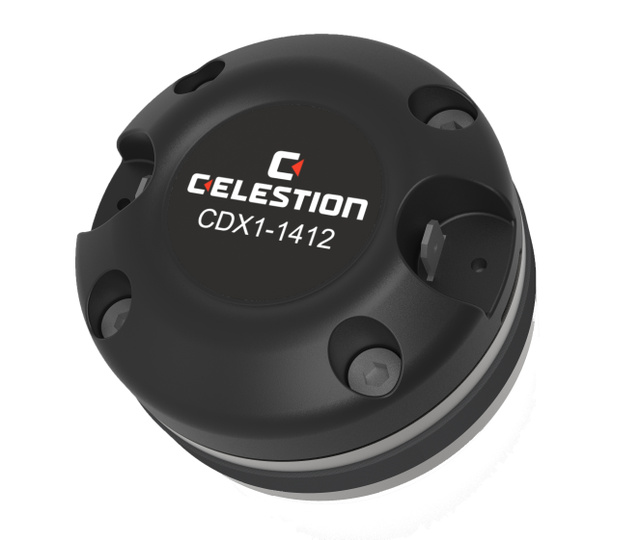
Ipswich, UK (June 15 2021) —Celestion, one of the world’s leading suppliers of professional loudspeakers and compression drivers for sound reinforcement applications is very pleased to introduce the new CDX1-1412 1” exit, neodymium magnet high frequency compression driver. The unit’s ultra-compact size makes it ideal for small two-way cabinet designs and other highly portable applications, at a very attractive price point.

The CDX1-1412 is the latest of Celestion’s high frequency compression drivers, and features plenty of output for a driver this size:  35W (AES standard), 70W (Continuous) power rating, and 107dB sensitivity across a 1500 to 20kHz frequency band.

Designed and developed at Celestion’s headquarters in Ipswich, England, the CDX1-1412 features a 34mm/1.4-inch diameter edgewound copper clad aluminium voice coil, and a 25mm/1.-inch exit size. The new driver provides 70-watt power handling and delivers a 107dB sensitivity performance over a frequency range of 1,500-20,000Hz, with a recommended crossover frequency of 2,000Hz. The unit features a single piece Polyimide film diaphragm and surround, and is fabricated using a rigid engineering thermoplastic with a standard 2xM5 bolt fitting. Acoustic foam is utilised to minimise internal air cavity resonances, dampening unwanted reflections from the inside of the cover.

“With a diameter of only 60mm, the CDX1-1412 is extremely compact for a one inch exit compression driver, enabling the device to be fitted into small cabinets where space is critical, or to be used with multiple driver horns,” explains Celestion Product Marketing Manager Ken Weller. “It has a highly optimised neodymium magnet assembly and a single piece polyimide diaphragm which means the driver rates at an impressively high 35-watt power handling, measured to AES standard. This makes the device a serious contender for a range of fixed install and compact array applications.”


Specifications

Power rating………………………………………. 35W

Continuous power rating……………………… 70W

Nominal impedance…………………………… Available in 8Ω & 16Ω

Sensitivity…………………………………………. 107dB

Frequency………………………………………… 1,500-20,000Hz

Recommended min. crossover…………. (12dB/oct) 2,000Hz

Magnet type……………………………………… Neodymium

Voice coil diameter…………………………….. 34mm/1.4in

Voice coil material……………………….Copper clad aluminium

Diaphragm material……………………………. Polyimide

Surround material………………………………. Polyimide


Mounting Information

Width……………………………………………….. 60mm/2.4in

Depth………………………………………………. 34.5mm/1.4in

Unit weight……………………………………….. 0.36kg/0.8lb

Fitting………………………………………..Flange (2x M5 holes on 52mm/2 .05in PCD)

Throat exit…………………………………… 25mm/1in

About Celestion

With worldwide headquarters in Ipswich, England, Celestion design, develop and manufacture high-quality professional audio loudspeakers and compression drivers for sound reinforcement; premium guitar and bass guitar loudspeakers. These world-renowned speakers are used onstage and in clubs, theatres and other venues the world over. Contact Celestion at: info@celestion.com and visit us on Facebook at www.facebook.com/celestion.

www.celestion.com

Guitarist and Hard Rock/Heavy Metal Producer Mark Lewis Counts on Celestion Speakers

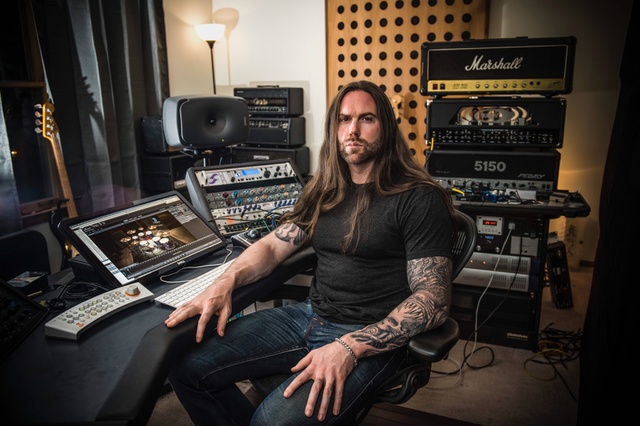
Nashville, TN (June 02, 2021) — Guitarist and Rock/Metal Producer Mark Lewis has tracked, mixed, produced, and/or mastered records for a variety of rock and metal’s heaviest bands, including Trivium, Bury Your Dead, Whitechapel, Chimaira, Battlecross, Cannibal Corpse, Megadeth, The Black Dahlia Murder, Carnifex, Havok, and many more. He recently sat down with Celestion to discuss his career, his tone-crafting techniques, and how Celestion speakers have been there through all of it.

“I grew up a guitar player, and went to college for music performance. I eventually went to Full Sail in Orlando, and wound up meeting Jason Suecof, who was just an up-and-coming producer at the time. He had just produced Trivium’s Ascendancy, which would turn out to be a gigantic record. When I got out of school was right about when he was starting to get in-demand and busy. He needed help in the studio, and the stars kind of aligned. The first thing Jason and I did together was the Roadrunner All Stars in 2005. We had done Bury Your Dead’s Beauty and the Breakdown and a couple of records for the Victory and Metal Blade labels.” In 2006, Lewis engineered Trivium’s album, The Crusade.”

Lewis also credits Suecof with pushing him to further his career. “Sometime at the end of 2007, Jason told me, ‘I’m not going to hire you as an engineer anymore. You’re going to pay me rent, work out of this studio, and I’m going to build another one.’ I guess he thought I was ready to leave the nest. I was terrified, but it turned out he was right.”

In terms of tone, for many years, Lewis explains his history with Celestion speakers.

“For many years I used the Vintage 30, which I might call Celestion’s flagship. I eventually went down the rabbit hole of different models and revisions. We took in a big shipment of Celestion in July of 2019 when I was working on the Havok record, V. We took a clean D.I. in and planned on re-amping. We had a great tone going on — an Engl cabinet with a Peavey 6534 tube head. I was trying that Engl because it had a sound halfway between a Mesa and a Marshall, and most of my clients want one or the other,” Lewis explains. “Normally our go-to would’ve been the Vintage 30, but we took literally a day to go through all the speakers and try them in the Engl. We had Lynchbacks, we had G12-H series, we had Redbacks, we had V-Type, we had Creamback 65 and Creamback 75, and I’m sure I’m leaving stuff out. The band unanimously decided the Creamback 65 was their favorite. Things quickly went from being — I wouldn’t say a stock Vintage 30 tone, but a familiar sound — to a real standout.”

And recently, Lewis describes a recent vintage acquisition that he revived with Celestion speakers.

“I just scored an amazing deal on a ’74 Marshall model 1960. It had a mixture of Greenbacks and some other original Celestion drivers. One had been re-coned by someone who did a terrible job. I replaced them all with a combination of Vintage 30s and G12s, and now this is my favorite cabinet, hands down.”

Read the full interview with Mark Lewis on the Celestion Speakerworld blog here and explore the complete range of Celestion speakers available to upgrade your tone here.

About Celestion and Celestion Guitar Speakers

An important element to essential British guitar tone since the birth of Rock & Roll, Celestion Guitar Speakers are famous for their lively and vocal midrange character with plenty of sparkle and chime. With worldwide headquarters in Ipswich, England, Celestion design, develop and manufacture premium guitar and bass loudspeakers, and high-quality professional audio drivers for sound reinforcement. These world-renowned speakers are used onstage and in clubs, theatres and other venues the world over. Contact Celestion at: info@celestion.com and visit us on Facebook at www.facebook.com/celestion.

www.celestion.com


Metal and Mettle: The Rise and Rise of Mark Lewis

In just over 15 years, producer and guitarist Mark Lewis has run up one of the most enviable — and loudest — discographies in rock. He has tracked, mixed, produced, and/or mastered records for a spectrum of metal’s heaviest bands, including Trivium, Bury Your Dead, Whitechapel, Chimaira, Battlecross, Cannibal Corpse, Megadeth, The Black Dahlia Murder, Carnifex, Havok, and many more. He recently sat down with us to discuss his humble beginnings, his career since, his tone-crafting techniques, and how Celestion speakers have been there through all of it.

What was your point of entry into metal and heavy rock?

For starters, I grew up a guitar player. I started at age 12 and went to college for music performance. I eventually went to Full Sail in Orlando, Florida, and have to say I didn’t enjoy the experience all that much. I loved the scene there, though, and wound up meeting Jason Suecof, who was just an up-and-coming producer at the time. He had just produced Trivium’s Ascendancy, which would turn out to be a gigantic record.

Was that the classic “big break” moment?

Yeah, we hit it off and became friends. When I got out of school was right about when he was starting to get in-demand and busy. He needed help in the studio, and the stars kind of aligned.

Shortly after that, you engineered a Trivium album, The Crusade.

That was in 2006. The first thing Jason and I did together was the Roadrunner All Stars in 2005. We had done Bury Your Dead’s Beauty and the Breakdown and a couple of records for the Victory and Metal Blade labels. Sometime at the end of 2007, Jason told me, “I’m not going to hire you as an engineer anymore. You’re going to pay me rent, work out of this studio, and I’m going to build another one.” I guess he thought I was ready to leave the nest. I was terrified, but it turned out he was right.

In your own work, what are your go-to drivers for various applications?

I have a perfect story. For so many years I used the Vintage 30, which I might call Celestion’s flagship. I eventually went down the rabbit hole of different models and revisions. We took in a big shipment of Celestion in July of 2019 when I was working on the Havok record, V. We took a clean D.I. in and planned on re-amping. We had a great tone going on — an Engl cabinet with a Peavey 6534 tube head. I was trying that Engl because it had a sound halfway between a Mesa and a Marshall, and most of my clients want one or the other.

Normally our go-to would’ve been the Vintage 30, but we took literally a day to go through all the speakers and try them in the Engl. We had Lynchbacks, we had G12-H series, we had Redbacks, we had V-Type, we had Creamback 65 and 75, and I’m sure I’m leaving stuff out. The band unanimously decided the Creamback 65 was their favorite. Things quickly went from being — I wouldn’t say a stock Vintage 30 tone, but a familiar sound — to a real standout. The 65 isn’t as popular as the 30, but I now believe it’s every bit as good.

Would you say the Creamback 65 is your new go-to?

Let me put it this way. On the records I’ve done since that big speaker tryout, I’ve usually sent clients a few tracks of guitar sounds and asked them to make a choice. Only, I don’t tell them which track uses what gear. There has been an overwhelming preference for the Creamback 65. The Vintage 30 still has a strong role, of course, for when we know we want that sound. On the last Whitechapel record we did, we used Marshalls with the driver that Celestion makes just for them, which I think is called the G12 Vintage.

Can you speak to how Celestion drivers interact with your favorite amps under the high-output demands of metal?

A lot of producers are scared of low end in guitar tracks. I’m first to admit I’m the other extreme — sometimes I’ll take some back out when we’re mixing. One thing that stands out about the Vintage 30, its Mesa and Marshall variants, and the Creamback 65 is, I can hit them with all the low end I want from the amp and the speaker reacts properly. I’m looking not just for boom like a cheap car subwoofer, but for the speaker to interact with the amp in a certain way that’s musical. This is apparent on the Havok record, where there was a lot of energy from 80 to 100 Hertz. I use the Celestion models because I know they’ll deliver this and not s*** the bed. I can’t say that about some other brands.

Tell us about your miking techniques and signal chain.

I almost always use a Shure SM57, almost always through a Neve 1073 preamp or high-end clone. I use Avid HD I/O, Apogee, or Black Lion converters. But that mic/preamp combo is always the basis for heavy guitars. I may add an older Sennheiser 421, but I’m very conscious about not complicating things with too many mics. Even with just two, I’m checking for phase issues so we don’t lose transient information and things like that. I start with the mic dead center, pointing at the dust cap of the cone, then may move it left or right, which removes more 10kHz the more you go. You want the right balance between not too bright and not too dark.

Have you ever used new Celestion drivers to bring a vintage acquisition back from the dead?

Recently, in fact. I just scored an amazing deal on a ’74 Marshall model 1960. It had a mixture of Greenbacks and some other original Celestion drivers. One had been re-coned by someone who did a terrible job. I replaced them all with a combination of Vintage 30s and G12s, and now this is my favorite cabinet, hands down.

What would you say is your desert island amp head?

That might be my Mesa Boogie Dual Rectifier, revision F. Or maybe my Driftwood Purple Nightmare. That brings up something I’d like people to understand. Yes, I have a lot of gear, and these days there are a lot of songwriting tools like plug-ins that model every option imaginable, but you don’t need every option. When bands like Metallica started, they had what they had. Not a million options. And where you lived at the time or your financial abilities had a lot more to do with what was available to you, so metal bands got their tones based on what was ready at hand. They made their gear limitations into their identity. When I’m working with a band, I try to start with what they know and what excites them in terms of tone.

Carrying that theme further, what would you say is the most valuable thing you didn’t learn in music school?

That you just need to do the work. No degree is going to put you on the street with the ability to get a big record. When you’re first out of school, studios and labels are going to expect you to work cheap or for free to get your name out there, and that’s not always bad. Live as minimalist as you can for as long as you can and invest in good gear. When I started, I was often sleeping at Jason Suecof’s studio and making maybe 800 bucks a month. I had a roof and could eat, but I didn’t have money for anything else. Fortunately, I didn’t do anything else.

You have to work up to where producers and artists trust you. That’s what happened with me. When Jason got busy, bands were like, “We loved working with Mark so maybe he can just do the record?” Of course, I wasn’t getting paid what he got, but you work your way up. Don’t be afraid to work with bands who need development, just like you do as a producer or engineer. You’ll learn together. That’s the thing that’s going to be your college.

PULSE 15 Bass Cab UPGRADE

‘My band has a replica of an Acoustic Amp 408 cabinet, it dates back to the seventies. The original speakers were a mix of types and brands, but basically these were 15” speakers rating at 75W each. The cab sounded great with our bass player’s vintage Ampeg Blueline SVT head and the Aguilar DB751 head. However, 2 of the 4 speakers gave out, so it was time for an upgrade. I suggested putting in the Celestion PULSE 15 as this would not only upgrade all 4 speakers, but also boost the overall power rating of the cab to 1600W.

I can confirm the setup never sounded this good, the low-end is just mind blowing, but even for a 4 x 15” bass cabinet, we get a clear, crisp and well defined bass sound with a lot of headroom.’

From Stephane V.

The Triple Cone Full Range LIVE Response Speaker

The F12M-150 Triple Cone is a new guitar speaker designed for use with profiling amps, modeling software, impulse responses, and the technology for emulating guitar amps and speaker cabinets.

Digital tone-emulation technology is more popular than ever, and guitarists who use it require full-range, flat and accurate output. General-purpose pro audio speakers (as in powered stage monitors) offer flat reproduction but are somewhat clinical sounding and lack the organic, immediate response guitar players want. On the other hand, traditional guitar speakers deliver immediacy and feel at the cost of accuracy, because they are purpose-built to generate more harmonic resonances the harder they are driven — which can undermine the work the profiling/modeling rig is already doing. Celestion’s F12-X200 was the world’s first speaker to combine the best of both these worlds, with the drawbacks of neither: we call it Full Range LIVE Response.

Now comes the F12M-150 Triple Cone which provides a solution for players seeking a Full Range Live Response speaker that is more compact and affordable than its big brother, the F12-X200.

The F12M-150 has a unique design featuring two additional tweeter cones integrated into the main woofer cone (making it “Triple Cone”). This enables the speaker to deliver near full-range frequency performance: from 60Hz up to 12kHz, for a rich and detailed sound, whatever your set-up.

Combining Celestion’s Pro Audio and guitar speaker know-how, response is flat and neutral, ensuring no unwanted colourations that could overwhelm the input signal. But with an optimised woofer cone and lighter moving mass the F12M-150 is designed to closely mimic the responsiveness of a traditional guitar speaker, delivering all the tactile feel you would expect from playing though a conventional guitar rig.

On the side of accuracy, the F12M-150 is a wide frequency range speaker, with response from 60Hz to 12kHz. The higher frequencies are reproduced using specially designed tweeter cones integrated into the speaker’s primary or “woofer” cone. This enables the F12M-150 to deliver a wide range of audible frequencies and harmonics. Not only that, special Celestion technology guards against unwanted sonic colouration of the input signal. All this ensures an accurate rendition of whatever amp/cabinet combination the musician is emulating.

On the side of immediacy, the F12M-150 employs proven design principles that have made Celestion royalty among guitar drivers since the dawn of rock and roll, such as straighter cone sides and a lighter moving mass compared with pro audio speakers. The physicality and tactile response of the speaker is live, as it would be playing through a traditional guitar amp.

The end result is that by using the F12M-150 in a monitor wedge, backline cabinet, or any familiar stage or studio application, guitarists can enjoy the instant fingers-to-music connection of their favorite amp setup alongside the multitude of amp setups offered by their solutions of choice for amp and cabinet emulation. As realistic as modeling technology has become, the Celestion F12-X200 makes it more real.

Specifications:
• Nominal diameter: 12”.
• Power rating: 150W.
• Impedance: 8Ω.
• Sensitivity: 96dB.
• Chassis type: Pressed steel.
• Voice coil diameter: 2”.
• Voice coil material: Round copper.
• Magnet type: Ceramic.
• Frequency Range: 60 – 12,000Hz.
• Resonance frequency (LF): 60Hz.